Bangalore Home Nursing Services for Elderly and Patient Care at Home: Your Complete Guide
Medically reviewed by Varolyn Clinical Team, Registered Nurses & Care Physicians · 30 Jun 2026
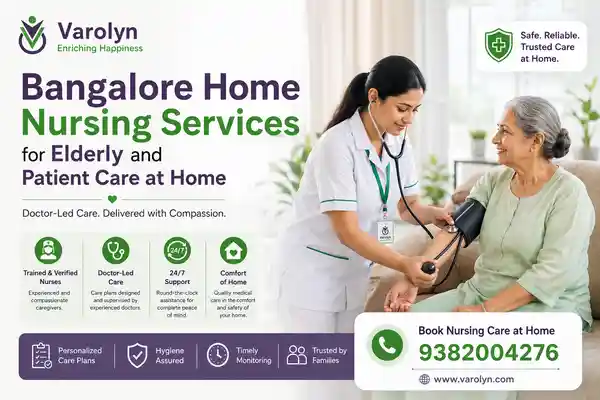
Your Loved One Deserves the Best Care — Right at Home
Picture this: your 74-year-old mother has just come home after a hip replacement surgery. She is tired, in mild pain, and a little anxious. The hospital discharge letter lists a dozen instructions. You have work, children, and responsibilities. And you are quietly terrified of getting something wrong.
You are not alone. Thousands of families in Bangalore face exactly this situation every single day.
The good news? Home nursing services in Bangalore have transformed the way families care for elderly parents and recovering patients. A qualified nurse comes to your home, follows the doctor's plan, and gives your loved one the focused, one-on-one attention that is simply not possible in a busy hospital ward.
This guide explains everything you need to know — what home nursing is, who needs it, what to expect, and how to choose the right provider in Bangalore.
What Are Home Nursing Services?
Home nursing services bring trained healthcare professionals — registered nurses, staff nurses, and skilled caregivers — directly to your home. They perform clinical tasks (medical procedures and monitoring) as well as personal care tasks (bathing, feeding, mobility) under the guidance of your treating doctor.
Think of it as having a mini-hospital room inside your own bedroom — minus the noise, the infections, and the discomfort of an unfamiliar environment.
What Does a Home Nurse Actually Do?
- Vital monitoring: Checking blood pressure, pulse, temperature, and oxygen levels (called SpO2 — the percentage of oxygen in the blood) regularly.
- Wound care: Cleaning and dressing surgical wounds, pressure sores (bed sores), or diabetic foot ulcers to prevent infection.
- Medication management: Giving medicines at the right time, in the right dose, exactly as the doctor has prescribed.
- IV therapy: Administering intravenous (through-the-vein) fluids, antibiotics, or nutrition when ordered by the doctor.
- Catheter care: Looking after urinary catheters (a thin tube that drains urine) to keep them clean and infection-free.
- Nasogastric (NG) tube feeding: Feeding patients through a tube that goes into the stomach, when they cannot eat by mouth.
- Tracheostomy care: Cleaning and maintaining a breathing tube (tracheostomy) in patients who need help breathing.
- Physiotherapy support: Helping the patient do gentle movement exercises prescribed by a physiotherapist.
- Personal hygiene: Bathing, grooming, and oral (mouth) care to keep the patient clean, comfortable, and dignified.
- Companionship and emotional support: Simply being present, talking, and reassuring patients who feel lonely or frightened.
Who Needs Home Nursing in Bangalore?
Home nursing is not only for the very sick. It is for anyone who needs more medical attention than family members can safely provide — and who recovers better and faster in the comfort of home.
Elderly Patients
Older adults in Bangalore often live with multiple long-term conditions at the same time — called comorbidities. These may include diabetes, high blood pressure (hypertension), heart disease, arthritis, or Parkinson's disease (a condition affecting movement). Managing all of these at home, without professional help, is overwhelming for any family.
A home nurse brings order, routine, and clinical expertise. They notice early warning signs — a slight drop in blood pressure, a new swelling, a change in behaviour — and alert the doctor before a small problem becomes a crisis.
Post-Surgery Recovery Patients
After operations like knee replacement, bypass surgery, fracture repair, or cancer surgery, patients need weeks of careful monitoring. Wounds must be dressed. Pain must be managed. Clots (dangerous blockages in blood vessels) must be watched for. A trained home nurse handles all of this systematically, following the surgeon's discharge plan step by step.
Stroke Survivors
A stroke (when blood supply to part of the brain is cut off) can leave a person partially paralysed, unable to speak clearly, or needing a feeding tube. Home nursing — combined with physiotherapy and speech therapy — dramatically improves recovery outcomes for stroke patients in their own familiar environment.
Cancer Patients Receiving Palliative Care
Palliative care means care that focuses on comfort, dignity, and quality of life rather than curing the illness. For cancer patients and their families, having a compassionate nurse at home provides pain relief, emotional support, and the priceless gift of spending meaningful time together at home rather than in a hospital.
Patients With Bedridden Conditions
Patients who are bedridden (unable to get up from bed) for any reason — a severe fracture, a neurological (nerve or brain) condition, or advanced age — are at high risk of pressure sores, lung infections (pneumonia), and muscle wasting. Regular repositioning, chest physiotherapy (gentle tapping on the back to clear mucus from the lungs), and skin care by a trained nurse prevent these dangerous complications.
New Mothers and Newborns
Post-natal (after childbirth) home nursing supports new mothers with recovery, breastfeeding guidance, and newborn care — especially helpful in Bangalore's busy urban households where extended family support may not always be available.
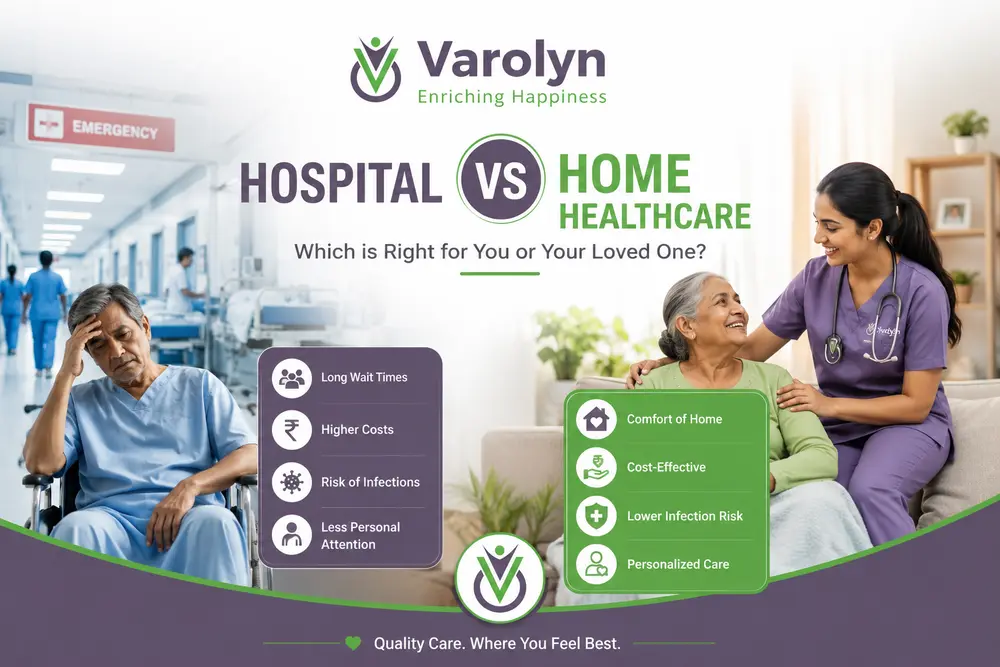
Why Home Is Often Better Than the Hospital
This surprises many families. Surely the hospital is the safest place? Not always — and here is why.
Faster Emotional Recovery
Research consistently shows that patients recover faster in familiar surroundings. Seeing their own curtains, smelling home-cooked food, and hearing the voices of family members reduces stress hormones (chemicals in the body that slow healing) and boosts morale. This is especially true for elderly patients, who can become disoriented and distressed in hospital environments.
Lower Risk of Hospital-Acquired Infections
Hospitals are busy places with many sick people. Hospital-acquired infections (infections that patients catch while in hospital) are a serious global concern. At home, the infection risk drops dramatically because the environment is controlled and familiar.
One-to-One Attention
In a hospital, one nurse may be responsible for eight to twelve patients at once. At home, the nurse's entire attention is on your family member. Every change, every concern, every need is noticed and addressed immediately.
Family Involvement
At home, family members can be actively involved in care — preparing preferred foods, providing emotional comfort, and learning simple care skills from the nurse. This involvement is healing in itself.
Cost Efficiency Over Time
For conditions that require weeks of monitoring, home care is often significantly more affordable than a prolonged hospital stay. Families in Bangalore avoid daily hospital accommodation costs, parking, food expenses, and the indirect cost of work missed by family caregivers who would otherwise need to stay at the hospital.
What Makes a Good Home Nursing Provider in Bangalore?
Not all home nursing services are the same. Choosing the right provider is one of the most important decisions you will make for your loved one. Here is what to look for.
Qualified and Verified Nurses
Every nurse should hold a recognised nursing qualification — a General Nursing and Midwifery (GNM) diploma or a Bachelor of Science in Nursing (B.Sc. Nursing) degree — and be registered with the Karnataka State Nursing Council. Ask the provider for proof of qualifications and background verification.
Doctor Coordination
A trustworthy provider does not work in isolation. They communicate regularly with your treating doctor, share daily reports, and immediately flag any concern. Care should always follow the doctor's prescribed plan.
Trained for Emergency Response
A nurse at home must know what to do in an emergency — whether that is a sudden fall in blood pressure, a seizure (sudden uncontrolled electrical activity in the brain), or difficulty breathing. They should be trained in Basic Life Support (BLS) — the set of techniques used to keep a person alive until an ambulance arrives.
Clear Communication With Families
The best providers give families daily updates, written care reports, and a clear escalation path — meaning a step-by-step plan of who to call and what to do if something goes wrong. You should never be left wondering what is happening.
Compassion and Cultural Sensitivity
In Bangalore's diverse, multilingual households, a nurse who is respectful, patient, and culturally sensitive makes an enormous difference to both the patient's comfort and the family's peace of mind. Look for providers who understand local languages, dietary habits, and family dynamics.
Home Nursing vs. Hiring a Helper Independently: What Families in Bangalore Should Know
Many families try to save money by hiring an independent nurse or helper through word of mouth. This seems practical, but it carries real risks.
- No background checks: You have no way to verify the person's qualifications, criminal record, or work history.
- No accountability: If something goes wrong — a medication error, a fall, a missed warning sign — there is no organisation to be accountable.
- No backup: If the individual falls sick or does not show up, your loved one is left without care.
- No clinical supervision: A helper with no nursing training cannot safely perform wound dressings, manage IV lines, or recognise clinical warning signs.
With a registered home healthcare provider like Varolyn Healthcare, every nurse is credentialled, insured, supervised, and backed by a clinical team. If one nurse cannot come, a replacement is arranged — care never stops.
What to Expect When You Start Home Nursing Services
Starting home nursing for the first time can feel daunting. Here is what the process looks like with a professional provider.
Step 1: Initial Assessment
A clinical coordinator (a healthcare professional who organises and oversees care) visits your home or speaks with you in detail. They assess the patient's condition, the home environment, the doctor's instructions, and the family's needs. This is a free, no-obligation consultation.
Step 2: Customised Care Plan
Based on the assessment and the treating doctor's advice, a personalised care plan is created. This plan details exactly what the nurse will do, how often, and what goals to aim for — for example, "wound healed by week 3" or "patient walking independently with support by week 6."
Step 3: Nurse Matching
The right nurse is selected based on the patient's specific needs, preferred language, and personality. Good providers treat this matching process seriously — the right fit makes a huge difference to how comfortable the patient feels.
Step 4: Daily Care and Reporting
The nurse arrives as scheduled, carries out the care plan, maintains a daily log (record) of vitals, observations, and any concerns, and communicates updates to the family and the treating doctor.
Step 5: Regular Review and Adjustment
As the patient's condition changes — improving or, sometimes, needing more support — the care plan is reviewed and updated. This keeps the care relevant, safe, and effective at every stage of recovery.
Specialist Home Care Services Beyond Basic Nursing
A full-spectrum home healthcare provider in Bangalore can offer much more than nursing alone. Here is what Varolyn Healthcare's comprehensive care model includes.
ICU at Home
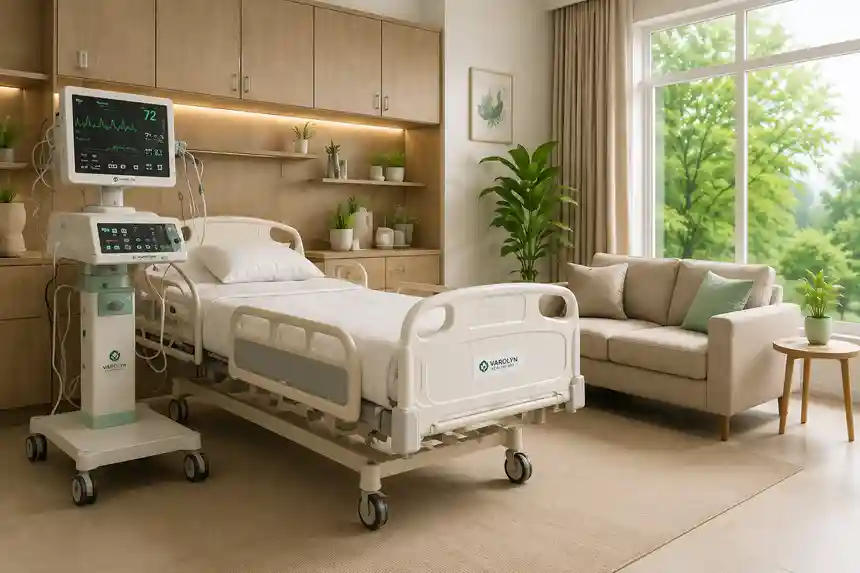
For patients who are critically ill but stable enough to be managed outside a hospital ICU (Intensive Care Unit — the ward for the most seriously ill patients), a full ICU setup can be brought home. This includes ventilators (machines that help a patient breathe), multiparameter monitors (devices that track multiple vital signs at once), infusion pumps, and a trained ICU nurse — all in your living room, with your family around you.
Physiotherapy at Home
A physiotherapist is a specialist in movement and rehabilitation (the process of regaining function after illness or injury). Home physiotherapy helps patients recovering from strokes, orthopaedic (bone and joint) surgeries, and neurological conditions regain strength, balance, and independence — without the exhausting journey to a clinic.
Elder Care and Companion Care
Beyond clinical tasks, many elderly patients in Bangalore simply need a reliable, caring companion. Elder care services combine light medical support (checking vitals, managing medicines) with companionship — going for walks, having conversations, supervising meals, and providing mental stimulation to prevent cognitive decline (a gradual loss of memory and thinking ability).
Medical Equipment at Home
ICU-level equipment — oxygen concentrators (machines that extract oxygen from room air), suction machines (devices that clear mucus from the airway), hospital beds with adjustable positions, and wheelchairs — can be supplied and set up in your home, making it safe and functional for even complex care needs.
Post-Surgery Recovery Care
The weeks after a major surgery are critical. Post-surgery home care combines nursing, physiotherapy, dietary guidance, and regular doctor-coordinated monitoring to give patients the best possible chance of a smooth, complication-free recovery.
Common Myths About Home Nursing — Busted
Many families hesitate to explore home nursing because of misconceptions. Let us clear them up.
- Myth: "Home nursing is only for very rich families."
Fact: Home nursing can be more affordable than extended hospital stays. Professional providers offer flexible plans — hourly, daily, or full-time — to suit different budgets. - Myth: "My family can manage on our own."
Fact: Family love is irreplaceable, but clinical care requires training. Trying to manage wound care, IV lines, or tracheostomy care without training puts both the patient and the caregiver at risk. - Myth: "Home nurses are not as qualified as hospital nurses."
Fact: Reputable providers employ the same category of qualified, registered nurses who work in hospitals. The only difference is the setting. - Myth: "The doctor will not support home care."
Fact: Most doctors in Bangalore actively recommend home nursing for suitable patients. Good home care providers work closely with the treating physician and share daily reports. - Myth: "It is only needed for very old people."
Fact: Home nursing benefits patients of all ages — young adults recovering from surgery, middle-aged patients managing a chronic illness, or new mothers adjusting to parenthood.
Signs It Is Time to Consider Home Nursing for Your Loved One
Sometimes families are unsure whether the situation has reached the point where professional help is needed. Here are some clear signs that it is time to call a home nursing provider.
- Your elderly parent has been recently discharged from hospital and still has open wounds, drains, or a catheter.
- You are struggling to give medicines at the right times — or you are worried about getting the doses wrong.
- Your loved one is bedridden and you have noticed redness or sores on the skin (early pressure sores).
- The patient is showing signs of confusion, memory loss, or wandering — which can be dangerous without supervision.
- You are exhausted from 24/7 caregiving and there is no one else to share the load.
- The doctor has recommended monitoring vital signs daily but there is no one at home trained to do it.
- A family member is living with a terminal (life-limiting) illness and you want them to be comfortable at home with dignity.
If any of these sound familiar, please do not wait. Early support prevents small problems from becoming serious ones.
Why Varolyn Healthcare Is Bangalore's Trusted Home Nursing Partner
At Varolyn Healthcare, we believe that great medical care should feel like great human care. Here is what sets us apart.
- Qualified, verified clinical team: Every nurse, physiotherapist, and caregiver on our team is credentialled, background-verified, and continuously trained to the highest standards.
- Doctor-coordinated care: We work directly with your treating physician, follow their plan precisely, and report back daily — so you and your doctor are always in the loop.
- Full spectrum of services: From basic nursing and elder care to full ICU-at-home setups, we cover every level of medical need under one roof.
- Rapid deployment across Bangalore: We serve patients across all major areas of Bangalore, with the ability to have a nurse at your door quickly when you need help urgently.
- Compassionate, family-centred approach: We treat every patient as a family member — not a case number. We speak your language, respect your culture, and support your whole family through difficult times.
- Transparent, honest communication: No surprises. We keep you informed, answer your questions, and involve you in every care decision.
Whether you need a nurse for a few hours a day, round-the-clock care, or a complete ICU-at-home setup, Varolyn is here — every step of the way.
Take the First Step: Book a Free Consultation Today
You do not have to figure this out alone. Our care coordinators are warm, experienced, and ready to listen — without any pressure or obligation.
In a free consultation, we will:
- Understand your loved one's current condition and needs.
- Explain exactly which services would help most.
- Answer every question you have, clearly and honestly.
- Help you take the next step with complete confidence.
📞 Call Varolyn Healthcare now to book your FREE home consultation. Let us bring safety, comfort, and expert care to your home — because your family deserves nothing less.
Key facts
- India has over 140 million citizens aged 60 and above, and this number is projected to double by 2050, creating a massive and growing demand for professional elderly care and home nursing services.
- Hospital-acquired infections (HAIs) affect a significant proportion of hospitalised patients globally. Home-based care dramatically reduces this risk by providing care in a controlled, familiar environment.
- Studies show that patients recovering from surgery or serious illness in their own homes often report lower stress levels, better sleep quality, and faster return to functional independence compared to extended hospital stays.
- A registered home nurse in India holds either a General Nursing and Midwifery (GNM) diploma or a B.Sc. Nursing degree and must be registered with the respective State Nursing Council to practice legally and safely.
- Pressure sores (also called bedsores or pressure ulcers) can develop in as little as 2 hours in immobile patients. Regular repositioning and skin assessment by a trained home nurse are the most effective ways to prevent them.
- Stroke is one of the leading causes of long-term disability in India. Home-based rehabilitation combining nursing care and physiotherapy has been shown to significantly improve functional recovery outcomes for stroke survivors.
- According to the World Health Organization (WHO), palliative care — which includes comfort-focused home nursing for patients with serious illnesses — significantly improves quality of life for both patients and their families.
Frequently asked questions
What is the difference between a home nurse and a home caregiver?
A home nurse is a clinically trained and registered healthcare professional who can perform medical procedures like wound dressing, IV therapy, catheter care, and vital monitoring. A home caregiver or attendant focuses on personal care tasks like bathing, feeding, and mobility support. Varolyn Healthcare provides both, and often pairs them for patients who need both clinical and personal care.
How quickly can a home nurse be arranged in Bangalore?
With a professional provider like Varolyn Healthcare, a nurse can typically be arranged within 24 hours of the initial assessment. For urgent post-discharge situations, the process can often be expedited further. It is always best to contact the provider as soon as you know the patient will be returning home.
Is home nursing safe for elderly patients with multiple health conditions?
Yes — when provided by qualified, experienced nurses who work under the guidance of the patient's treating doctor, home nursing is very safe for elderly patients with multiple conditions. In fact, for many elderly patients, home care reduces the risk of hospital-acquired infections and the distress of an unfamiliar environment, which can make conditions like dementia worse.
Can a home nurse handle emergencies?
Reputable home nurses are trained in Basic Life Support (BLS) and know exactly what to do in an emergency — whether that means stabilising the patient, alerting the family, calling an ambulance, or contacting the treating doctor immediately. Varolyn Healthcare nurses also have direct access to a clinical supervisor for guidance at any time of day or night.
How is a home nursing care plan decided?
The care plan is developed by Varolyn's clinical coordinator based on three inputs: the patient's current medical condition and history, the treating doctor's discharge instructions and ongoing orders, and the family's specific needs and home environment. The plan is reviewed regularly and updated as the patient's condition changes.
Does Varolyn Healthcare provide home nursing services outside Bangalore?
Varolyn Healthcare primarily serves Bangalore and its surrounding areas, with the ability to cover all major localities across the city. For enquiries about services in other cities or pan-India requirements, we encourage you to contact us directly so we can guide you to the best available care options.
What should I prepare at home before the nurse arrives?
Your Varolyn care coordinator will guide you through this during the initial assessment. Generally, you will need a clean, well-lit space for the patient, a basic first-aid kit, any medicines already prescribed, and medical reports or discharge summaries from the hospital. Our team will advise on any specific equipment or supplies needed based on your loved one's individual care plan.