Hospital vs Home Healthcare in Bangalore: Which Is Right for You?
Medically reviewed by Team Varolyn, Author · 28 Jul 2026
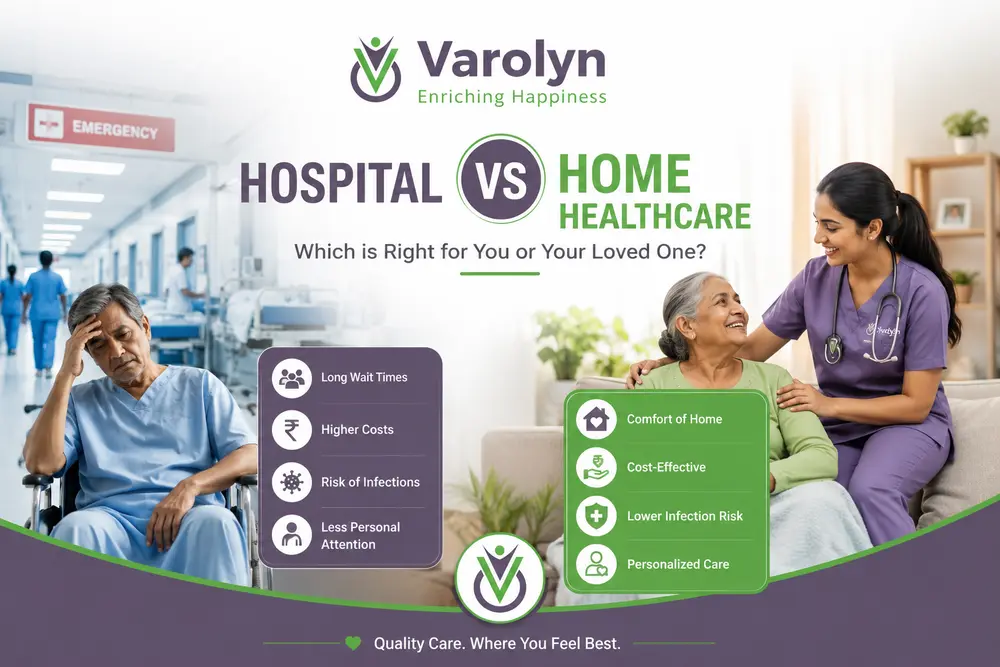
A Question Every Bangalore Family Faces Sooner or Later
Picture this: your father has just had a knee-replacement surgery at a hospital in Koramangala. The doctor says he is stable and can be discharged. But your mother is worried. "What if something goes wrong at home? Shouldn't he stay in the hospital a little longer?"
This exact conversation happens in thousands of Bangalore homes every single day. And it is completely understandable. When someone we love is unwell, we want the best possible care — and for most of us, "best" has always meant "hospital."
But that picture is changing fast. Home healthcare in Bangalore has grown into a full, professional service that brings ICU-level equipment, trained nurses, physiotherapists, and doctors right to your door. In many cases, recovering at home is not just good enough — it is actually better.
This guide will walk you through everything you need to know: the real differences between hospital and home care, when each option makes sense, what home care actually looks like, and how to choose wisely for your loved one.
What Exactly Is Home Healthcare? (And What It Is Not)
Home healthcare is organised, medical-grade care delivered at the patient's home by trained clinical professionals. It is not just a family member helping someone bathe or eat. It is a structured care plan — prescribed by a doctor — and carried out by qualified nurses, physiotherapists, respiratory therapists, and other specialists.
Modern home healthcare in Bangalore can include:
- ICU at Home: Intensive care unit monitoring with ventilators (machines that help a patient breathe), cardiac monitors, infusion pumps, and 24/7 nursing — all set up in the patient's bedroom.
- Home Nursing: Trained nurses for wound care, medicine administration, tube feeding, catheter (a thin tube used to drain fluids) care, and vital-sign monitoring.
- Physiotherapy at Home: Exercise-based rehabilitation (recovery therapy) for stroke, orthopaedic surgery, Parkinson's disease, and more — done in the comfort of the patient's own space.
- Post-Surgery Recovery: Structured care after operations like hip replacement, bypass surgery, or abdominal surgery, so the patient heals safely without a prolonged hospital stay.
- Elder Care: Compassionate, round-the-clock support for senior citizens who need help with daily activities, medication, and health monitoring.
- Medical Equipment Rental: Medical-grade beds, oxygen concentrators (devices that pull oxygen from the air), wheelchairs, suction machines, and more — delivered and set up at home.
In short, if a patient is medically stable — meaning their condition is not in an acute emergency phase — almost everything a hospital ward can do can now be done at home.
The Big Differences: Hospital Care vs Home Healthcare Side by Side
Let us look at the key dimensions honestly, without hype.
1. Environment and Comfort
In a hospital: Shared rooms, unfamiliar smells, constant noise, disrupted sleep, and strict visiting hours. For elderly patients and children, this environment alone can cause anxiety and slow recovery. There is even a recognised medical term for this: hospital-induced delirium (sudden confusion caused by the hospital environment), which is more common in seniors.
At home: The patient sleeps in their own bed, eats familiar food, hears familiar voices, and is surrounded by family. Multiple studies have found that patients in familiar environments heal faster, feel less pain, and have lower stress hormone levels. For dementia (a condition that affects memory and thinking) patients especially, the home environment is deeply calming.
2. Risk of Infections
In a hospital: Hospitals are full of sick people, and some of the bacteria there are resistant to common antibiotics (medicines that fight bacteria). Hospital-acquired infections — called nosocomial infections — affect a significant number of admitted patients globally. In Indian hospitals, with high patient loads, this risk is even more real. Common examples include catheter-related urinary infections, ventilator-associated pneumonia (lung infection), and surgical-site infections.
At home: The patient's home has familiar, manageable bacteria. A professionally trained home-care nurse follows strict hygiene protocols. The risk of picking up a resistant infection is dramatically lower. This single benefit alone is one of the strongest reasons doctors recommend early discharge with home care for many patients.
3. Cost
In a hospital: A single day in a private hospital in Bangalore — especially in ICU — can cost anywhere from several thousands to tens of thousands of rupees. Week-long admissions for recovery or monitoring can run into lakhs. And these costs often include services the patient does not actually need at that stage of recovery.
At home: Professional home healthcare is significantly more affordable than equivalent hospital care. You pay for exactly the services and hours you need. Equipment is rented rather than purchased. There are no hidden facility charges, room rates, or cafeteria bills. For families managing long-term or chronic (ongoing) conditions, this difference adds up to enormous savings over months.
4. Personalised Attention
In a hospital: A busy ward nurse may be responsible for 8 to 15 patients at once. Doctors do rounds (brief visits to check on patients) once or twice a day. Your loved one gets a fraction of a professional's attention at any given moment.
At home: A home nurse is focused entirely on your family member. There is no competing priority. Care is deeply personalised. The nurse notices small changes early — a slight drop in blood pressure, a new swelling, a change in breathing — because they are watching one patient, not a whole ward.
5. Family Involvement
In a hospital: Visiting hours are limited. Families feel helpless, waiting outside. They cannot easily be part of the care process.
At home: Family members are present, informed, and involved. A good home healthcare provider trains family members on what to look for and how to assist. This involvement is proven to improve patient morale (mental strength and positivity) and recovery speed.
6. Mental and Emotional Wellbeing
Being in a hospital for a long time takes a real mental toll — on both patient and family. Patients often feel powerless, bored, and disconnected. Depression (persistent sadness and low mood) after long hospitalisation is well-documented. At home, patients feel a sense of control, dignity, and normalcy. These are not soft benefits — they have real, measurable effects on healing.
When Is Hospital Care the Right Choice?
Home healthcare is powerful, but it is honest to say: hospitals are irreplaceable in certain situations. Always consult your doctor for the right decision. Generally, hospital care is needed when:
- The patient needs emergency surgery or a procedure that requires an operation theatre.
- The patient is in an acute (sudden and severe) crisis — heart attack, stroke, severe trauma, or major organ failure — and needs immediate specialist intervention.
- Diagnosis is still unclear and requires multiple complex tests, scans, or specialist consultations happening simultaneously.
- The patient needs a blood transfusion (receiving donated blood) or a specialised intervention that cannot be safely replicated at home.
- There is a risk to the patient's safety that cannot be managed in a home environment.
The bottom line: hospitals are for emergencies, surgeries, and complex diagnostics. Once a patient is stable, the hospital's job is largely done — and that is exactly where home healthcare takes over brilliantly.
When Is Home Healthcare the Smarter Choice?
This is where home healthcare truly shines. Consider home care when:
- The patient has been discharged from hospital and needs continued wound care, nursing, or rehabilitation (recovery exercises).
- An elderly parent needs ongoing monitoring for conditions like diabetes, hypertension (high blood pressure), or heart failure — but does not need to be admitted.
- A patient needs long-term ventilator support (breathing machine) and is medically stable — home ICU care avoids months of expensive hospital bills.
- A loved one needs palliative care (comfort-focused care for serious illness) and wishes to spend their time at home with family.
- A patient recovering from a stroke, orthopaedic surgery, or neurological (brain and nerve) condition needs daily physiotherapy and nursing but is not in danger.
- A senior citizen needs help with daily activities, medication reminders, and health checks — without needing full hospitalisation.
- The family wants to reduce hospital re-admissions by catching warning signs early through regular monitoring at home.
What Does a Typical Day of Home Healthcare Look Like in Bangalore?
Let us paint a real picture. Here is what home care might look like for Mrs. Leela, a 68-year-old woman in Jayanagar recovering from a hip-replacement surgery.
7:00 AM: The home nurse arrives, checks vital signs (blood pressure, oxygen levels, heart rate, temperature), helps Mrs. Leela with her morning hygiene, and administers her prescribed medicines.
9:00 AM: The physiotherapist arrives. They guide Mrs. Leela through 40 minutes of gentle exercises designed to rebuild strength in her hip and improve her walking. They do this in her living room, with her granddaughter cheering her on.
12:00 PM: The nurse helps with lunch, checks the surgical wound for any signs of infection, changes the dressing (sterile bandage), and records all observations in a care log.
4:00 PM: The nurse does another vital-sign check and gives evening medication. Mrs. Leela naps comfortably in her own bed, with the fan at her preferred setting.
8:00 PM: A night-duty nurse takes over, ensuring Mrs. Leela is safe, comfortable, and has everything she needs through the night.
Meanwhile, Mrs. Leela's daughter has access to daily updates from the care team. She feels informed, not helpless. And Mrs. Leela? She tells everyone she is recovering twice as fast as she expected — because she is happy.
Home ICU Care in Bangalore: What Is Possible?
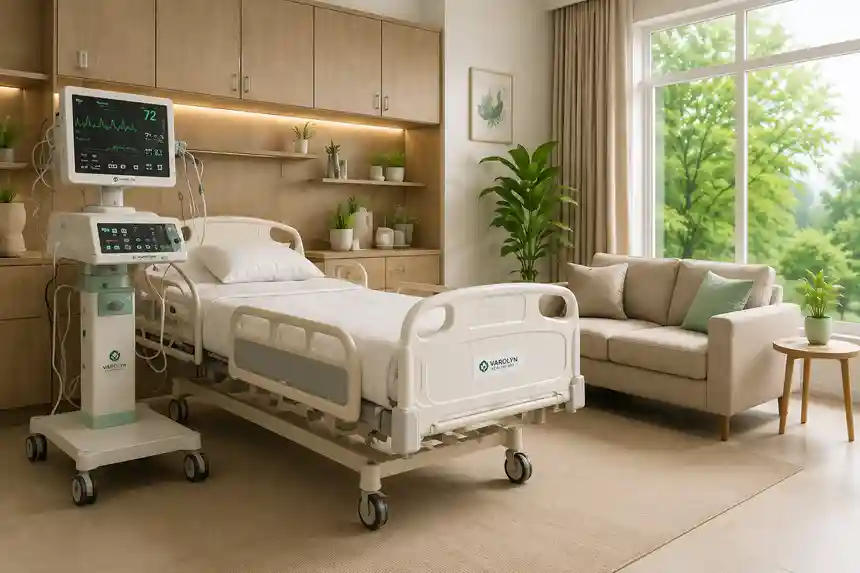
One of the most remarkable developments in home healthcare is the ability to set up a proper ICU (Intensive Care Unit) at home. This is not science fiction — it is happening in apartments across Bangalore right now.
A home ICU setup by a provider like Varolyn Healthcare can include:
- Ventilator — a machine that helps or takes over breathing for patients who cannot breathe adequately on their own.
- Cardiac monitor — a screen that continuously shows the heart's electrical activity (ECG), oxygen levels, and blood pressure.
- Infusion pump — a device that delivers exact doses of liquid medicines, fluids, or nutrition through a vein or tube.
- Suction machine — clears the airway of secretions (mucus) for patients who cannot cough effectively.
- ICU-level bed — adjustable for comfort and to prevent bedsores (painful skin wounds caused by constant pressure).
- 24/7 critical care nurses and a supervising doctor — trained professionals who monitor and respond just as they would in a hospital ICU.
For patients with conditions like COPD (Chronic Obstructive Pulmonary Disease — a long-term lung condition), advanced neurological diseases, or those on long-term ventilator support after an injury, home ICU care can mean years of dignified, comfortable life rather than years spent in a hospital room.
Addressing the Most Common Fears About Home Healthcare
It is normal to have doubts. Let us address the fears we hear most often from families in Bangalore.
"What if there is an emergency?"
A professional home healthcare team has emergency protocols in place. They are trained in first aid and basic life support (CPR — techniques to keep blood and oxygen flowing in a cardiac arrest). They have direct lines to coordinating doctors and will arrange hospital transfer quickly if needed. In most cases, their regular monitoring catches problems before they become emergencies.
"Are home nurses as qualified as hospital nurses?"
At Varolyn Healthcare, all clinical staff are qualified, registered professionals — nurses with GNM (General Nursing and Midwifery) or BSc Nursing degrees, physiotherapists with BPT (Bachelor of Physiotherapy) qualifications, and supervisory doctors with MBBS and specialist degrees. Credentials are verified, and training is ongoing. You should always ask any home healthcare provider about their staff qualifications — and a good provider will be proud to share them.
"Won't we miss important tests and check-ups?"
Home healthcare teams can arrange for many tests to be done at home — blood tests, ECGs (heart electrical tests), urine tests, and more. For tests that require hospital equipment, they coordinate appointments and accompany the patient if needed. The care team also stays in close communication with the treating doctor, sharing daily reports.
"Is home care only for rich families?"
This is a common misconception. Home healthcare is often far less expensive than the equivalent number of days in a private hospital. Families across income levels in Bangalore are now choosing it as a smart, cost-effective option. Many insurance policies also cover home healthcare — always check with your insurer.
"What about hygiene at home?"
Professional home care nurses follow the same infection-control protocols as hospital staff — hand hygiene, sterile dressing techniques, safe disposal of medical waste, and more. In fact, your home is a cleaner environment than a hospital ward in most cases, simply because it has far fewer sick visitors.
Home Healthcare for Elderly Parents in Bangalore: A Special Note
Bangalore is home to a large and growing population of senior citizens, many of whom live semi-independently or with adult children who work full-time. The challenge of elder care is real and deeply felt.
For ageing parents with conditions like Alzheimer's disease (a form of dementia that affects memory), Parkinson's disease (a condition affecting movement and balance), diabetes, or heart disease, hospitalisation is often distressing and disorienting. They lose their routines. They become confused. They feel frightened.
Home-based elder care gives them:
- Consistent, familiar routines that support mental clarity.
- A companion and caregiver who learns their preferences, moods, and needs.
- Regular health monitoring that catches issues before they become crises.
- Dignity — the ability to live life on their own terms, in their own space.
For working children in Bangalore who cannot take leave to care for a parent, professional home care is also a profound gift of peace of mind. You can be at your desk in Whitefield or Marathahalli and know that someone qualified and caring is with your mother in Malleshwaram.
How Bangalore's Growth Makes Home Healthcare More Relevant Than Ever
Bangalore's hospitals are excellent — but they are also under enormous pressure. The city's population has grown faster than its healthcare infrastructure. Waiting times are long. Beds are limited. ICU availability during health crises (like the COVID-19 pandemic showed us vividly) can become critically scarce.
Home healthcare is not just a convenience — it is a strategic part of Bangalore's healthcare ecosystem. When stable patients move home, hospital beds open up for those who truly need emergency care. The system works better for everyone.
Moreover, Bangalore's notorious traffic means that daily hospital visits for dressing changes, physiotherapy, or medication can consume hours. Having care come to your home in HSR Layout, Indiranagar, or Yelahanka saves time, reduces exhaustion, and removes a real logistical burden from already-stretched families.
How to Choose the Right Home Healthcare Provider in Bangalore
Not all home healthcare providers are equal. Here is what to look for — and ask about — before you commit.
- Qualified, verified staff: Ask for credentials of nurses, physiotherapists, and supervising doctors. A trustworthy provider will share these readily.
- Clear care plans: The provider should give you a written care plan based on the treating doctor's prescription, not a vague verbal promise.
- 24/7 availability: Illness does not follow office hours. Your provider must be reachable around the clock.
- Transparent pricing: No hidden charges. You should know exactly what you are paying for.
- Equipment quality: Medical-grade, well-maintained equipment is non-negotiable. Ask how frequently machines are serviced.
- Doctor oversight: There should be a qualified doctor supervising all clinical decisions, even if they are not physically present every hour.
- Communication: Regular updates to the family and to the treating hospital doctor. A care log you can read anytime.
- Reviews and track record: Look for genuine reviews from Bangalore families. Ask for references if you are unsure.
Varolyn Healthcare: Bringing Hospital-Quality Care to Your Home in Bangalore
At Varolyn Healthcare, we have built our service around one belief: every patient deserves to heal with dignity, comfort, and expert care — and that does not have to mean staying in a hospital.
We provide a full spectrum of home healthcare services across Bangalore, including:
- ICU at Home with 24/7 critical-care nursing and doctor supervision.
- Post-surgery recovery care for all major procedures.
- Home nursing for wound care, tube feeding, IV (intravenous — into the vein) medicines, and more.
- Physiotherapy and rehabilitation for stroke, orthopaedic, and neurological conditions.
- Compassionate elder care for senior citizens who wish to age at home.
- Medical equipment rental and setup — hospital beds, ventilators, oxygen concentrators, and more.
Our team is made up of registered nurses, certified physiotherapists, and experienced doctors who are passionate about making home care work for your family. We believe in transparency, warmth, and clinical excellence — all under one roof, delivered to your door.
If you are weighing your options for a loved one — whether it is post-discharge care, long-term management, or elder support — we would love to talk. A conversation costs nothing, and it might give you the clarity and confidence you need.
Book a FREE consultation with Varolyn Healthcare today. Our care advisors will listen, understand your situation, and guide you honestly — even if the answer turns out to be that hospital care is the right choice for your loved one right now. That is the kind of trust we want to earn.
The Bottom Line: It Is Not Hospital vs Home — It Is the Right Care at the Right Time
The best healthcare is not about choosing one option and sticking to it forever. It is about matching the right level of care to what the patient actually needs at each stage of their journey.
Hospitals are irreplaceable for emergencies, surgeries, and acute crises. But for the long weeks and months of recovery, management, and support that follow — or for ongoing conditions that do not require admission — home healthcare in Bangalore is often the safer, kinder, and smarter choice.
Your loved one deserves to heal in peace. They deserve familiar faces, their own pillow, and food that tastes like home. With the right team behind them, they can have all of that — and excellent medical care too.
That is the promise of modern home healthcare. And it is happening right now, in living rooms across Bangalore.
Key facts
- Hospital-acquired infections (nosocomial infections) affect a significant percentage of admitted patients worldwide, and risk is lower in a professionally managed home care setting due to reduced exposure to resistant pathogens.
- Multiple clinical studies have found that patients recovering in familiar home environments report lower pain levels, reduced anxiety, and faster functional recovery compared to those in hospital wards.
- ICU at home — including ventilator support, cardiac monitoring, and 24/7 critical-care nursing — is now a viable, clinically safe option for medically stable patients in Bangalore.
- Hospital-induced delirium, a state of sudden confusion triggered by the unfamiliar hospital environment, is particularly common in elderly patients and can significantly delay recovery.
- Home healthcare typically costs substantially less than equivalent private hospital care in Bangalore, as patients pay only for the services they need without room, facility, or overhead charges.
- India's home healthcare market is growing rapidly, driven by an ageing population, rising hospital costs, growing awareness of infection risks, and improved availability of clinical professionals for home-based care.
- Family involvement in patient recovery — which is far greater in a home care setting — is associated with improved patient morale, better medication adherence, and reduced rates of depression during recovery.
Frequently asked questions
Is home healthcare in Bangalore as safe as staying in a hospital?
For medically stable patients, home healthcare can be just as safe — and in some ways safer — than hospital care. Professional home care providers follow strict clinical protocols, use medical-grade equipment, and have trained nurses monitoring the patient around the clock. One key advantage is the significantly lower risk of hospital-acquired infections, which are a serious concern in busy hospital wards. However, for emergencies, surgeries, and acute crises, hospital care is irreplaceable. Always consult your treating doctor before transitioning to home care.
How much does home healthcare cost compared to a hospital stay in Bangalore?
Home healthcare is generally significantly more affordable than an equivalent hospital stay in Bangalore, particularly for recovery and long-term care. Hospital costs include room charges, facility fees, nursing charges, and more — even when a patient is stable and does not need high-intensity interventions. With home care, you pay for exactly the services your loved one needs. Many health insurance policies also now cover home healthcare — check with your insurer for details. Contact Varolyn Healthcare for a transparent, no-obligation cost discussion.
What conditions can be managed through home healthcare in Bangalore?
A wide range of conditions can be safely managed at home by trained professionals. These include post-surgery recovery (after hip replacement, bypass surgery, abdominal surgery, etc.), stroke rehabilitation, COPD and respiratory conditions requiring ventilator support, diabetes and hypertension management, wound care, palliative care for serious illness, dementia and Alzheimer's care, and physiotherapy for neurological and orthopaedic conditions. The key is that the patient must be medically stable. A qualified doctor should assess and prescribe the home care plan.
How do I know if my elderly parent needs home nursing or a hospital admission?
If your parent has a known, diagnosed condition that is stable — meaning it is not suddenly getting much worse — and their main needs are monitoring, medication, daily assistance, and companionship, home nursing is often the right choice. Signs that hospital admission is needed include sudden severe chest pain, difficulty breathing, loss of consciousness, a major fall with possible fracture, sudden confusion or stroke symptoms, or uncontrolled bleeding. When in doubt, call your doctor immediately. A home healthcare provider like Varolyn can also help you assess the situation.
Can a home ICU in Bangalore really replace a hospital ICU for ventilated patients?
For patients who are ventilator-dependent but otherwise stable — meaning they are not in an acute, rapidly changing crisis — a properly set up home ICU can absolutely provide the monitoring, equipment, and nursing care they need. Varolyn Healthcare sets up full home ICU environments with ventilators, cardiac monitors, infusion pumps, and 24/7 critical-care nurses supervised by a doctor. This is far more comfortable and cost-effective for long-term ventilated patients than remaining in a hospital ICU. However, if a patient's condition is unstable or changing rapidly, hospital ICU care is essential.
Are Varolyn Healthcare's home nurses and physiotherapists qualified?
Yes. All clinical staff at Varolyn Healthcare are registered, qualified professionals. Nurses hold GNM (General Nursing and Midwifery) or BSc Nursing degrees, physiotherapists hold BPT (Bachelor of Physiotherapy) qualifications, and the team is supervised by qualified doctors with MBBS and specialist credentials. Credentials are verified before hiring, and ongoing training is provided. You are always welcome to ask about the qualifications of the professional assigned to your family member.
Does home healthcare cover areas across Bangalore, including outskirts like Whitefield or Yelahanka?
Yes, Varolyn Healthcare provides home healthcare services across Bangalore, including central areas like Indiranagar, Koramangala, and Jayanagar, as well as outer areas like Whitefield, Yelahanka, Marathahalli, HSR Layout, and Malleshwaram. Contact us to confirm availability in your specific location. We are also expanding our services to other major cities across India.