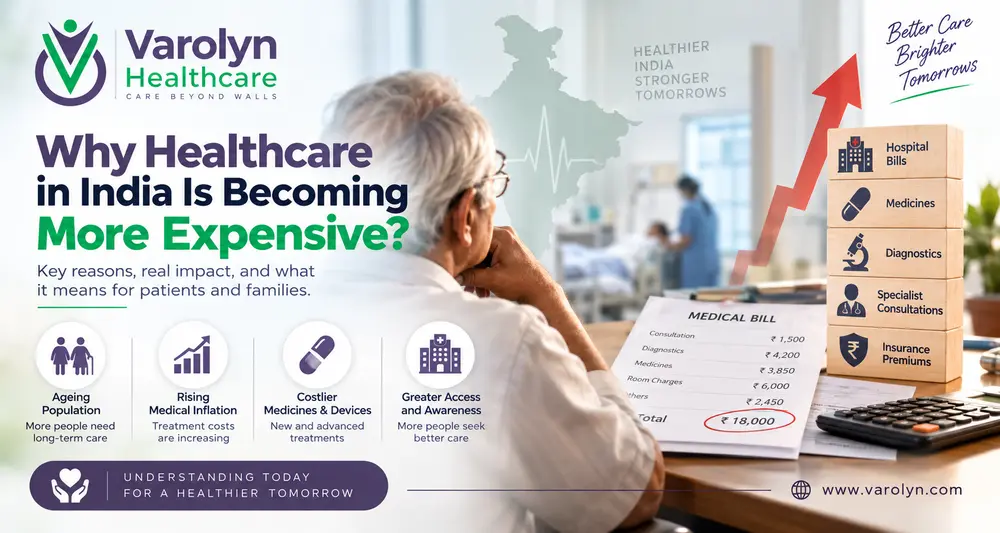
Why Healthcare in India Is Becoming More Expensive — And How Home Healthcare Can Help
Medically reviewed by varolyn healthcare, Team Varolyn Healthcare · 21 Sept 2026
That Hospital Bill That Left Your Family Speechless
Picture this: a loved one is discharged after a week in a private hospital in Bangalore. The family is relieved — but then the billing counter hands over an invoice. The number has so many digits that someone reads it twice. A week of care has cost more than a month's salary. Maybe two.
If this sounds familiar, you are not alone. Healthcare costs in India have been climbing steadily for years, and millions of families — from middle-income households in Bengaluru to small towns across Karnataka — are feeling the squeeze.
This article explains exactly why healthcare in India is becoming more expensive, who is most affected, and what practical steps your family can take — including the growing option of high-quality home-based care — to get the medical attention you need without financial ruin.
How Fast Are Medical Costs Really Rising?
India's medical inflation — the rate at which healthcare prices go up — has been running at roughly 14% per year, which is almost double the general inflation rate. That means the cost of a procedure or hospital stay that cost ₹1 lakh five years ago could easily cost ₹1.9 lakh today.
A few numbers that put this in perspective:
- The cost of a standard private hospital room in a metro city like Bangalore can range from ₹5,000 to ₹30,000 per night, not counting doctor fees, medicines, or tests.
- Heart surgery that cost ₹2–3 lakh a decade ago can now cost ₹5–10 lakh or more at a top private hospital.
- Out-of-pocket health spending in India remains among the highest in the world — nearly 50–60% of total health expenditure still comes directly from patients' pockets.
These are not just statistics. Behind each number is a family that skipped savings, borrowed money, or delayed treatment because the cost felt impossible.
The 7 Biggest Reasons Healthcare Is Getting Costlier in India
Understanding the "why" helps families make smarter decisions. Here are the main forces pushing costs up.
1. Hospital Infrastructure Is Extremely Expensive to Build and Run
Modern private hospitals are incredibly costly to build. High-end operation theatres, intensive care units (ICUs — the special ward for very serious patients), MRI machines, and ventilators (machines that help patients breathe) all cost crores of rupees. The hospital passes these costs on to patients through higher room rates and procedure charges.
In Bangalore alone, several new "super-specialty" hospitals have opened in the last decade. Each one represents thousands of crores in investment — and that investment needs to be recovered.
2. Imported Medical Technology and Medicines
Many of the most advanced medical devices — robotic surgery systems, high-resolution scanners, specialised ICU monitors — are imported from the United States, Germany, or Japan. When the Indian rupee weakens against the dollar or euro, the cost of these machines rises automatically. That extra cost flows straight into your hospital bill.
Similarly, many specialty medicines, especially for cancer, rare diseases, or complex surgeries, are either imported or made with imported raw materials. Currency fluctuations and global supply chain problems (like those seen during COVID-19) can cause drug prices to spike sharply.
3. Growing Demand for Specialist Doctors
India has a serious shortage of doctors, especially specialists — doctors who are experts in one area, like a cardiologist (heart doctor) or a neurologist (brain and nerve doctor). The ratio of doctors to patients in India is still well below the World Health Organization's recommended level.
When demand is high and supply is low, prices rise. A consultation with a senior specialist in a private hospital in Bangalore can cost ₹1,000 to ₹3,000 — just for a 15-minute appointment. Many families visit two or three specialists before getting a clear diagnosis, multiplying the cost quickly.
4. An Ageing Population With Complex Needs
India's population is getting older. By 2050, it is estimated that India will have over 300 million people above the age of 60. Older adults tend to have multiple health conditions at the same time — for example, diabetes, high blood pressure, and a heart condition all together. Managing these conditions requires more visits, more medicines, and more monitoring.
Chronic (long-term) disease management is ongoing and expensive. Unlike a single surgery that ends, conditions like diabetes or Parkinson's disease (a condition affecting movement and balance) require care for years or decades. This sustained demand pushes healthcare costs higher for the entire system.
5. Low Health Insurance Penetration
Health insurance means a company shares your medical costs in exchange for a yearly fee. Despite growth in recent years, a large portion of Indians — especially in semi-urban and rural areas — still have no health insurance. Even among those who do, many policies have limits, exclusions, or sub-limits that leave large bills uncovered.
Without insurance to negotiate bulk rates or absorb costs, most patients pay the full "retail" price listed by the hospital. This is almost always higher than what large insurers pay.
6. Defensive Medicine and Over-Testing
Defensive medicine means that doctors sometimes order extra tests or procedures not because they are certain the patient needs them, but to protect themselves legally — just in case. While this is understandable in a system where medical litigation is rising, it adds unnecessary costs for the patient.
An MRI scan, for example, can cost ₹5,000 to ₹20,000 in Bangalore. If it is ordered "just to be safe" without strong clinical reasons, that is a significant avoidable expense.
7. Rising Staff and Operational Costs for Hospitals
Good nurses, paramedics, and trained hospital staff are in high demand globally. Private hospitals in India increasingly compete to attract skilled nurses, which means higher salaries. Add to this the rising cost of electricity, medical waste disposal, safety equipment, and regulatory compliance — and running a modern hospital becomes more expensive every year. These operational costs are eventually billed to patients.
Who Suffers the Most When Healthcare Becomes Unaffordable?
Not everyone experiences rising costs the same way. Some groups are hit much harder.
- Middle-income families — too "wealthy" to qualify for government schemes, but not wealthy enough to absorb large private hospital bills easily.
- Senior citizens — who need care most often but often live on fixed incomes like pensions or savings.
- Patients with chronic conditions — who need ongoing, repeated care rather than a single episode of treatment.
- Families recovering from a major illness or surgery — who face costs not just during hospital admission, but also during the long recovery period after discharge.
- People in Tier-2 cities or suburbs of metros like Bangalore — who must travel long distances to access quality care, adding transport and lodging costs.
If your family falls into any of these groups, the financial pressure can feel overwhelming. But there is a growing solution that is changing how families across India think about medical care.
Home Healthcare: The Smarter, More Affordable Alternative
Here is an important truth that many families in Bangalore and across India are only now discovering: not all medical care needs to happen inside a hospital.
A large percentage of the care that happens in hospitals — monitoring vital signs (heartbeat, blood pressure, oxygen levels), wound dressing, physiotherapy (exercises and therapies that help the body recover), IV drips (medicine given directly into the vein), and nursing care — can be delivered safely and effectively in the comfort of a patient's own home.
Home healthcare is not a compromise. It is a medically proven model that reduces costs, lowers the risk of hospital-acquired infections (infections that patients catch while staying in the hospital), and dramatically improves the emotional wellbeing of patients — especially the elderly.
How Much Can Home Healthcare Actually Save?
The savings are real and often significant. Consider a few comparisons:
- A private ICU bed in Bangalore can cost ₹15,000 to ₹50,000 per day. ICU-level care at home — with trained nurses, monitoring equipment, and medical oversight — can be a fraction of that cost, while keeping the patient in a familiar, stress-free environment.
- Post-surgery hospital stays cost thousands of rupees daily just for the room. Transitioning to post-hospitalization recovery care at home can cut daily costs dramatically while still providing professional wound care, medicine management, and rehabilitation support.
- A full-time hospital private nurse shift costs money — but so does every meal, every linen change, and every administrative fee the hospital adds to your bill. At home, costs are transparent and tailored to exactly what your family needs.
- Families caring for an elderly parent with dementia (a condition that affects memory and thinking) or mobility challenges often keep them in expensive nursing homes when dedicated elder care at home can provide companionship, medical monitoring, and personal care at a comparable or lower cost — with the priceless benefit of family closeness.
Beyond money, the emotional cost of being separated from family during recovery is real. Studies consistently show that patients recover faster in familiar, comfortable surroundings.
What Kinds of Care Can Be Delivered at Home?
Many families are surprised by how much is possible at home. Here is a snapshot of what professional home healthcare providers like Varolyn Healthcare can deliver right to your doorstep in Bangalore:
Nursing and Medical Monitoring
Trained nurses can visit daily or stay round-the-clock. They can check vital signs, manage feeding tubes, give injections, change wound dressings, and monitor recovery from surgery. Professional home nursing in Bangalore brings hospital-grade nursing care to your living room.
Physiotherapy and Rehabilitation
After a stroke (when blood flow to the brain is blocked or a blood vessel bursts), a hip replacement, or a serious injury, physiotherapy is essential. A physiotherapist (a trained movement specialist) designs exercises to help the body regain strength, balance, and independence. Physiotherapy at home saves patients the exhausting and costly effort of travelling to a clinic multiple times a week — especially when they are still weak or in pain.
Doctor Consultations at Home
Travelling to a hospital for a routine follow-up visit can be exhausting and expensive — especially for bedridden patients, elderly individuals, or those with breathing difficulties. Having a qualified doctor visit at home for check-ups, prescription renewals, and wound assessments saves time, money, and enormous physical strain.
ICU-Level Care at Home
For patients who need advanced monitoring — oxygen support, ventilator assistance, or intensive post-surgical observation — home ICU setups are now a reality. This is not a makeshift arrangement. Varolyn's ICU at home in Bangalore uses professional-grade equipment and trained critical care nurses to provide the same monitoring and intervention capability as a hospital ICU, at a significantly lower cost.
Elder Care and Companionship
Elderly patients with chronic conditions, reduced mobility, or cognitive decline (gradual loss of memory or thinking ability) benefit enormously from consistent, compassionate home-based care. Rather than an expensive nursing home or repeated hospital admissions, elder care at home provides a trained caregiver who becomes a trusted companion and a watchful health monitor.
Is Home Healthcare Safe? Addressing Common Worries
This is the most important question families ask — and it deserves a direct, honest answer.
Yes, home healthcare is safe when delivered by qualified, trained professionals with proper equipment and medical supervision. Here is what makes it safe:
- Trained staff: Professional home healthcare nurses go through rigorous clinical training. They know how to recognise warning signs and act quickly.
- Doctor oversight: Good home healthcare is always supervised by a qualified doctor who reviews the care plan regularly.
- Clear escalation protocols: If a patient's condition deteriorates, there is a clear plan to transfer them to a hospital immediately. Home care is not about avoiding hospitals — it is about using them only when truly necessary.
- Lower infection risk: Hospital-acquired infections (like MRSA or urinary tract infections from catheters) are a genuine and serious problem in hospitals worldwide. At home, the patient is in a clean, familiar environment with far fewer infection sources.
- One-on-one attention: In a busy hospital ward, one nurse may be responsible for 10–20 patients. At home, your loved one gets undivided attention.
Of course, home healthcare is not suitable for every situation. Emergencies, major surgeries, and complex procedures still require a hospital. A good home healthcare provider will always be honest with you about when hospital care is the right call.
Practical Tips to Manage Rising Healthcare Costs in India
While home healthcare is a powerful tool, here are some broader steps families can take to protect themselves from medical inflation:
- Get health insurance now, not later. Even a basic family floater policy (one policy that covers the whole family) can save lakhs of rupees when a major illness strikes. Do not wait until someone is already sick — most insurers will not cover pre-existing conditions (health problems that already exist when you buy the policy).
- Use government health schemes. Schemes like Ayushman Bharat provide free treatment at empanelled (approved) hospitals for eligible families. Check if your family qualifies.
- Ask for itemised bills. You have the right to ask a hospital to break down every charge. Billing errors and duplicate charges are more common than most patients realise.
- Consider generic medicines. Generic medicines contain the same active ingredient as branded medicines but cost significantly less. Ask your doctor if a generic version is available and appropriate.
- Plan for post-hospital care early. The most expensive part of recovery is often the extra days spent in the hospital simply because the family is not ready to bring the patient home. Arranging home care before discharge can shorten the hospital stay and cut costs sharply.
- Regular preventive check-ups. Catching a problem early — before it becomes a crisis — is almost always cheaper than treating an advanced disease. Annual health check-ups are an investment, not an expense.
The Bigger Picture: A Healthcare System Under Pressure
It is also worth understanding the macro (large-scale) forces at play. India's public healthcare system — government hospitals and clinics — is stretched thin. While the government has made major investments in recent years, the public system still struggles to meet the needs of 1.4 billion people. This pushes more patients towards private healthcare, where costs are largely unregulated and can vary enormously.
The COVID-19 pandemic accelerated several trends: it exposed gaps in hospital capacity, pushed telemedicine (doctor consultations by video call) into mainstream use, and made families far more aware of the risks of crowded hospital environments. One lasting positive from the pandemic is that home-based care gained enormous credibility and acceptance among both patients and the medical community.
Going forward, a "hybrid" model — where hospitals handle acute emergencies and complex procedures, while home healthcare handles recovery, monitoring, and chronic disease management — is increasingly seen as the most sensible and sustainable path for India.
Why Bangalore Families Are Choosing Home Healthcare
Bangalore is one of India's most progressive cities when it comes to adopting new healthcare models. Several factors make home healthcare particularly well-suited to Bangalore families:
- Traffic and distance: Bangalore's infamous traffic means a trip to the hospital can take hours. For a weak or elderly patient, that journey is exhausting. Home care eliminates it entirely.
- Nuclear families: Many Bangalore families are nuclear (just parents and children, without extended family nearby). When one member is ill, others cannot always take time off work to accompany them to hospital. Home care brings the professional to the patient.
- Tech-savvy population: Bangalore families are comfortable with technology-enabled services delivered to their homes — from food to groceries to, now, healthcare.
- High awareness: The city's educated population increasingly understands that quality care does not require a hospital building around it.
Varolyn Healthcare: Bringing Quality Care to Your Home
At Varolyn Healthcare, we understand how much is at stake when a loved one is unwell. We know that the last thing a worried family needs is a confusing, impersonal healthcare system that sends them away with an enormous bill and little support.
That is why we have built a team of trained nurses, physiotherapists, critical care specialists, and caregivers who deliver compassionate, professional-grade medical care directly to homes across Bangalore. Whether your loved one needs round-the-clock nursing after surgery, physiotherapy following a stroke, or gentle elder care support, we are here — at your home, on your schedule, with total transparency.
We believe that quality healthcare should not be a luxury reserved for those who can afford long hospital stays. It should be available to every family, delivered with warmth, skill, and dignity.
If rising hospital costs are worrying you, or if you are planning a discharge and wondering what comes next, we warmly invite you to take the first step.
Book a free consultation with Varolyn Healthcare today. Our care coordinators will listen, understand your situation, and explain exactly what home-based care can do for your family — with no obligation and no pressure.
You do not have to face this alone. Varolyn is here to help.
Key facts
- India's medical inflation runs at approximately 14% per year — nearly double the country's general inflation rate — making healthcare costs one of the fastest-rising expenses for Indian families.
- An estimated 50–60% of total health expenditure in India is paid directly out of patients' pockets, one of the highest out-of-pocket ratios in the world.
- A private ICU bed in a metro city like Bangalore can cost between ₹15,000 and ₹50,000 per day, excluding doctor fees, medicines, diagnostic tests, and consumables.
- India is projected to have over 300 million citizens above the age of 60 by 2050, dramatically increasing the demand — and cost — of chronic and elderly care.
- Hospital-acquired infections affect millions of patients worldwide each year; home-based care in a familiar, clean environment significantly reduces this risk.
- The World Health Organization recommends a doctor-to-patient ratio of 1:1,000; India's ratio is still well below this benchmark, contributing to high specialist consultation fees.
- Studies consistently show that patients recovering from surgery or serious illness at home in familiar surroundings experience lower stress levels, better sleep, and faster recovery compared to extended hospital stays.
Frequently asked questions
Why is healthcare so expensive in India compared to other countries?
Healthcare in India is expensive primarily because of high out-of-pocket costs — meaning patients pay directly rather than through insurance. Low insurance penetration, expensive imported medical equipment, a shortage of specialist doctors, rising hospital construction costs, and the growing burden of chronic diseases all contribute. India's medical inflation rate of around 14% per year is nearly double the general inflation rate.
Is home healthcare in Bangalore cheaper than staying in a private hospital?
In most cases, yes — significantly so. A private ICU or hospital room in Bangalore can cost ₹15,000 to ₹50,000 per day, not including doctor fees, medicines, or tests. Home healthcare provides professional nursing, monitoring, and rehabilitation at a fraction of that cost, with the added benefit of a familiar, infection-free environment.
What medical conditions can be managed at home?
Many conditions can be safely managed at home with professional support. These include post-surgery recovery, stroke rehabilitation, management of chronic diseases like diabetes or heart failure, palliative care (comfort care for serious illness), wound care, physiotherapy, and monitoring of elderly patients with multiple health conditions. A qualified doctor will advise whether home care is appropriate for a specific patient.
Is home healthcare safe for elderly patients?
Yes, when provided by trained professionals with proper equipment and medical supervision, home healthcare is very safe for elderly patients. It also carries a lower risk of hospital-acquired infections, provides one-on-one attention, and supports better emotional wellbeing — all of which contribute to faster and smoother recovery.
How can I reduce my family's healthcare costs in India?
Key steps include buying comprehensive health insurance while family members are healthy, checking eligibility for government schemes like Ayushman Bharat, asking hospitals for itemised bills, asking doctors about generic medicines, scheduling regular preventive health check-ups, and planning home-based post-hospital care to reduce the number of days spent in a costly hospital.
What is the difference between home nursing and a caregiver or attendant?
A home nurse is a clinically trained healthcare professional who can administer medicines, dress wounds, manage medical equipment, monitor vital signs, and respond to medical emergencies. A caregiver or attendant primarily provides non-medical support — help with bathing, feeding, moving around, and companionship. Many patients benefit from both working together as part of a comprehensive home care plan.
How do I arrange home healthcare after a hospital discharge in Bangalore?
The best time to arrange home healthcare is before the patient is discharged, so that care begins the moment they arrive home. You can contact a provider like Varolyn Healthcare, describe the patient's condition and needs, and a care coordinator will design a personalised care plan. This typically includes a home assessment, equipment setup if needed, and scheduling of nurses, doctors, or physiotherapists.