Home Care vs. Assisted Living: Which is Right for Your Parent?
Medically reviewed by Varolyn Healthcare · 10 Nov 2026
The Question That Keeps Families Up at Night
Picture this: your father has just been discharged from a hospital in Bangalore after a knee replacement. He moves slowly, needs help getting to the bathroom, and cannot cook for himself. Your mother is in her seventies and already managing her own health. You live forty minutes away and have a full-time job. What do you do?
Or maybe your situation is different. Your mother has been forgetting things — gas left on, medicine skipped, doors unlocked at night. The worry is constant. Friends suggest an assisted living facility. Your mother refuses to even hear the word "old-age home." You are stuck in the middle, wanting only the best for her.
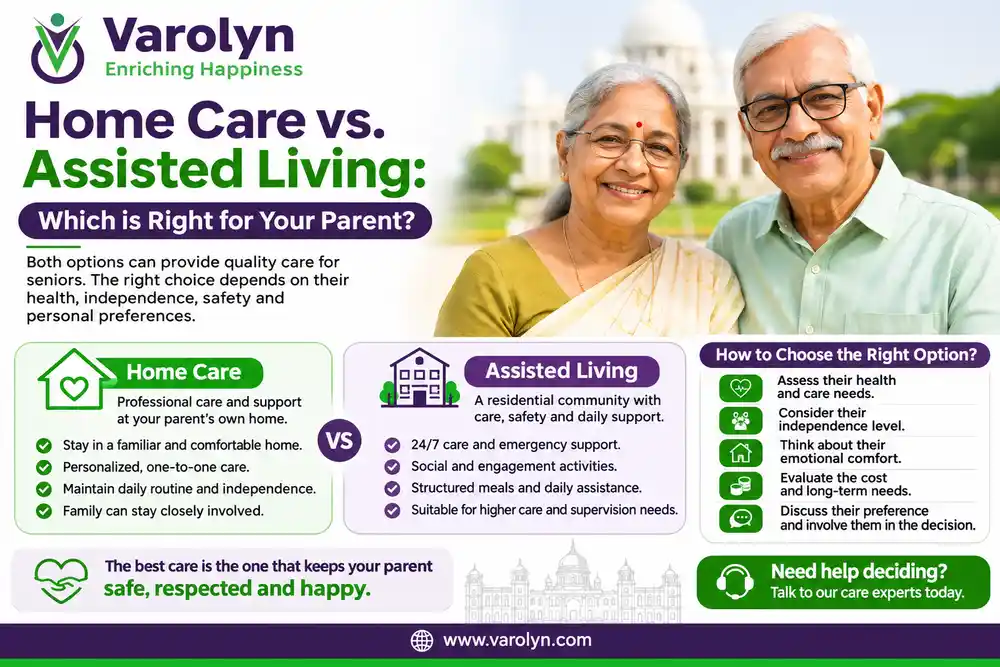
This exact dilemma — home care vs. assisted living — is one of the hardest decisions a family can face. There is no single right answer. But there IS a clear, logical way to think it through. This guide will walk you through every important factor, in plain language, so you can make a decision you feel good about.
What Exactly Is Home Care?
Home care means bringing professional medical and personal support to your parent's home, rather than moving your parent to a facility. It is a broad term that covers several types of help.
Types of Home Care Services
- Personal care: Help with bathing, dressing, grooming, and moving around safely.
- Home nursing: A trained nurse visits regularly to give medicines, change wound dressings, monitor blood pressure or blood sugar, and manage medical equipment. You can explore home nursing services in Bangalore for a detailed look at what this involves.
- Physiotherapy at home: A physiotherapist (a movement and exercise specialist) visits to help your parent regain strength, balance, and mobility after surgery or illness. Physiotherapy at home is especially valuable after a stroke or hip replacement.
- Doctor visits: A qualified doctor comes to your parent's home for check-ups, prescription reviews, and health monitoring. Doctor visits at home save long, tiring trips to a clinic.
- ICU-level care at home: For seriously ill patients, advanced monitoring equipment and trained critical-care nurses can be set up at home. This is sometimes called ICU at home and is growing rapidly as a trusted alternative to prolonged hospital stays.
- Companion care: A caregiver who provides company, helps with meals, and watches for safety concerns.
In short, home care is flexible. You choose exactly what your parent needs, and that plan can change as their health changes.
What Is Assisted Living?
Assisted living is a residential facility — a place where your parent moves in and lives full-time, surrounded by staff and other residents. It sits between fully independent living and a hospital or nursing home.
What Assisted Living Typically Offers
- A private or semi-private room in a shared building
- Three meals a day in a communal dining area
- 24-hour staff presence for general assistance
- Housekeeping and laundry services
- Group activities and social events
- Basic medical monitoring (not full nursing or ICU care)
In India, assisted living facilities are still relatively new and are mostly found in metro cities like Bangalore, Mumbai, Pune, Hyderabad, and Chennai. Quality varies widely, and costs can be significant.
It is important to understand what assisted living is not: it is not a hospital, and most facilities are not equipped to handle serious or complex medical conditions. If your parent's health deteriorates significantly, they may still need to shift to a hospital or add separate home-care support.
The 6 Most Important Factors to Compare
Let us break down the real differences across the factors that matter most to Indian families.
1. Medical Needs: How Much Care Does Your Parent Actually Require?
This is the starting point for every conversation.
- Low medical needs (mostly social support, help with daily tasks, mild memory issues): Both options can work. The choice often comes down to your parent's wishes and your family's ability to coordinate care.
- Moderate medical needs (diabetes management, wound care, post-surgery recovery, mild stroke effects): Home care with a skilled nurse and regular doctor visits is usually very well-suited and often superior to what an assisted living facility can provide.
- High medical needs (ventilator support, complex IV medications, advanced dementia with behavioural symptoms, serious infections): This is where many families feel unsure. Here is the reassuring truth — today's advanced home healthcare, including ICU-at-home care, can safely manage many conditions that families assume can only be handled in a hospital or facility. A clinical assessment by a qualified doctor will tell you what is genuinely possible at home.
Key point: Always have a doctor assess your parent's specific medical needs before deciding. Do not assume a facility is the only safe option for a medically complex parent.
2. Emotional Wellbeing: Where Will Your Parent Be Happiest?
Research consistently shows that most older adults strongly prefer to stay in their own homes. This is called ageing in place. And this preference is especially strong in Indian culture, where home carries decades of memories, relationships, and identity.
- Being at home reduces anxiety and depression in many elderly patients.
- Familiar surroundings help people with memory problems (like dementia — a condition that causes gradually worsening forgetfulness and confusion) stay calmer and more oriented.
- Pets, a favourite chair, the smell of your mother's kitchen — these things matter more than we sometimes realise.
- Assisted living can be socially enriching for some people, especially those who are isolated at home and enjoy group activities. But the transition is a major life change and can be emotionally difficult.
Ask your parent directly. Their voice should be central to this decision. Even if they have some cognitive decline, their preferences and feelings are still valid and important.
3. Safety: Can Your Parent Be Safe at Home?
Safety is the most common reason families consider assisted living. But many home-safety concerns can be addressed without uprooting your parent.
- Fall prevention: A physiotherapist can assess your parent's risk of falling and recommend exercises, walking aids, and home modifications (grab bars, non-slip mats, better lighting).
- Medication management: A home nurse can organise medications and ensure they are taken correctly and on time — one of the most common safety failures at home.
- 24-hour supervision: For parents who need constant watching, a live-in caregiver or rotating nursing shifts at home can provide round-the-clock presence, just as a facility would — but in the comfort of home.
- Emergency response: Personal emergency alert devices (small wearable buttons that call for help) and regular check-in calls can greatly improve home safety.
Assisted living does offer a built-in safety net of on-site staff. But it is worth carefully asking any facility: what is the staff-to-resident ratio at night? What happens if my parent falls at 2 AM? The answers may surprise you.
4. Cost: What Will Each Option Actually Cost in India?
Cost is a major factor for most Indian families, and it is worth being honest about the numbers.
- Assisted living in Indian metro cities (Bangalore, Mumbai, Pune, etc.) typically costs anywhere from ₹25,000 to ₹1,20,000 or more per month, depending on the room type, location, and services included. Premium facilities in Bangalore can be even higher.
- Home care costs vary based on the level of care needed. Part-time nursing visits, a daytime caregiver, or periodic physiotherapy sessions can be significantly more affordable than a full residential facility. Even round-the-clock home nursing — where a nurse is present at all times — is often comparable in cost to mid-range assisted living, with the added benefit that your parent stays home.
- Home care is also scalable: you pay only for what you need. If your parent only needs a nurse to visit twice a day, you pay for two visits. In a residential facility, you pay for the full package whether or not all services are used.
Important: Always get a detailed cost breakdown from any provider. Ask what is included, what costs extra, and what happens if your parent's needs increase. Varolyn Healthcare offers transparent, customised care plans — contact Varolyn for a free consultation to understand exactly what home care would cost for your parent's situation.
5. Family Involvement: How Much Can You Participate?
Home care keeps your family in the centre of your parent's life.
- You can visit freely, at any time, without visiting-hour restrictions.
- You can observe and supervise the care being given.
- You can share meals, celebrations, and ordinary moments with your parent.
- The caregiver or nurse becomes a familiar face your parent trusts — not a rotating roster of strangers.
In assisted living, visiting policies, physical distance, and institutional routines can sometimes create a subtle distance between families and their loved one. This is not always the case — some facilities are wonderfully family-friendly — but it is worth considering.
On the other hand, if family members live very far away (say, in another city or abroad) and cannot regularly coordinate care, an assisted living facility with on-site staff may genuinely offer more consistent daily supervision.
6. Cultural and Social Fit: Does It Feel Right?
In Indian families, the idea of placing a parent in a residential facility still carries emotional weight. Many elderly parents themselves feel it signals abandonment, even when their children are making the decision out of pure love and concern.
- Home care aligns naturally with the Indian value of caring for elders within the family system.
- It allows your parent to maintain their daily religious routines, dietary preferences, language comfort, and social connections with neighbours and friends.
- Many elderly people in Bangalore find comfort in familiar surroundings — their puja room (prayer space), their garden, their local temple, their long-time domestic help.
None of this means assisted living is a wrong choice. Some parents genuinely enjoy the social life of a facility and thrive there. But the cultural and emotional fit deserves honest, open conversation with your parent — without guilt on either side.
When Is Home Care Clearly the Better Choice?
Home care tends to be the strongest option when:
- Your parent strongly wishes to stay at home
- They have a stable medical condition that can be monitored by visiting nurses and doctors
- They are recovering from surgery or illness and need temporary intensive support (post-hospitalisation care at home is ideal for this)
- They have dementia and are calmer in familiar surroundings
- Family members live nearby and can supplement professional care
- Cost is a significant concern
- Your parent has strong social ties in their neighbourhood or apartment community
When Might Assisted Living Be Worth Considering?
Assisted living may be worth exploring when:
- Your parent lives completely alone in a city far from all family, with no support network at all
- They are genuinely socially isolated and desperately crave daily structured company and group activities
- They have been assessed by a doctor as requiring 24-hour supervision that the family truly cannot coordinate, even with professional home care support
- Your parent personally and enthusiastically wishes to try assisted living after understanding all their options
Even in these situations, it is worth getting a thorough home-care assessment first. You may find that a live-in caregiver, combined with nursing visits and regular doctor check-ins, addresses all these concerns at home.
A Practical Step-by-Step Decision Guide for Indian Families
Feeling overwhelmed? Follow these steps, one at a time.
- Step 1 — Get a medical assessment. Ask a doctor (ideally one who specialises in elder care) to evaluate your parent's current health, likely trajectory, and care needs. This is the foundation of every other decision.
- Step 2 — Talk to your parent. Have an honest, calm conversation. What does your parent want? What are they afraid of? What matters most to them? Listen more than you speak.
- Step 3 — List the specific tasks that need doing. Write down every activity your parent needs help with: bathing, medicines, meals, mobility, medical monitoring, company. This list will tell you what kind of support you need.
- Step 4 — Get a home-care assessment. Contact a reputable home healthcare provider (like Varolyn) and ask for a free home assessment. They will tell you exactly what can be done at home, with what staffing and equipment, and at what cost.
- Step 5 — Visit any assisted living facilities you are considering. If you are still weighing both options, visit at least two facilities in person. Look at the rooms, the dining area, the activities, the staff attitude, and — crucially — talk to residents and their families.
- Step 6 — Compare honestly and decide together as a family. Put the costs, benefits, and your parent's wishes side by side. Make the decision as a family, with your parent's voice at the centre.
- Step 7 — Know that you can adjust. This does not have to be a permanent, irreversible choice. Many families start with home care, adjust the level of support as needs change, and find it works beautifully long-term. Others try one approach and switch. Flexibility is a strength, not a failure.
How Varolyn Healthcare Makes Home Care Work for Real Families
Varolyn Healthcare was built for exactly this situation — families in Bangalore and across India who want their elderly parent to receive outstanding medical care without leaving home.
Here is what makes professional home healthcare different from simply hiring a local helper:
- Medically trained professionals: Varolyn's team includes qualified nurses, physiotherapists, doctors, and critical-care specialists — not just caregivers. Your parent's health is monitored with clinical skill.
- Customised care plans: There is no one-size-fits-all package. Every parent's plan is built around their specific diagnosis, mobility level, daily routine, and family situation.
- Continuity of care: The same caregivers and nurses visit regularly, building a trusting relationship with your parent. This consistency is especially important for elderly patients who are anxious or have memory difficulties.
- Family communication: Varolyn keeps families informed and involved. You will always know what is happening with your parent's health, even if you live in a different city.
- Scalable support: Start with two nursing visits a day. Add physiotherapy after a surgery. Scale up to 24-hour care if needed. Scale back when your parent improves. The plan moves with life.
- Compassionate approach: Varolyn's caregivers understand Indian culture, family values, and the emotional weight of this period. They are trained not just in medical skills, but in dignity, patience, and empathy.
Whether your parent needs comprehensive elder care at home, or a specific service like physiotherapy or wound care, Varolyn can design a plan that gives your parent the life they deserve — in the place they love most.
Real Questions Families Ask — Answered Honestly
Before wrapping up, let us address a few more things families often wonder about but rarely say out loud.
"Am I a bad child for considering assisted living?"
Absolutely not. Considering every option — including assisted living — is an act of love, not abandonment. What matters is that you are taking your parent's needs seriously and trying to make a thoughtful decision. The fact that you are reading this article proves your care and commitment.
"What if my parent's condition changes suddenly?"
Home care plans can be adjusted quickly. A good home healthcare provider like Varolyn has protocols for health emergencies and can rapidly increase the level of support. If your parent ever needs hospital-level care at home, services like ICU at home can be activated. And if hospitalisation becomes necessary, Varolyn's team can coordinate a smooth transition and provide expert post-hospitalisation care once your parent is ready to return home.
"My parent refuses all help. What do I do?"
This is very common. Many elderly people associate accepting help with losing independence. The key is to frame professional care as adding support, not taking control. Sometimes having a doctor (rather than a family member) explain the need for care makes it easier for a parent to accept. Starting small — perhaps just one nursing visit a week — can also ease the transition gently.
"How do I know if a home care provider is trustworthy?"
Look for a provider that employs verified, trained clinical professionals (not just unverified helpers), has a clear escalation plan for emergencies, provides written care plans, and communicates transparently with families. Ask for references or testimonials. Varolyn Healthcare is happy to answer all these questions openly — call or WhatsApp Varolyn for a free, no-obligation consultation.
Making the Decision With Love and Confidence
There is no perfect choice in this situation. There is only the most informed, most loving choice you can make with the information and resources you have right now.
For the vast majority of Indian families, professional home care is a powerful, medically sound, emotionally sensitive option that keeps your parent where they belong — at home, surrounded by everything and everyone they love.
It is not the easier choice in terms of coordination. But it is often the richer choice in terms of quality of life, dignity, and family connection. And with the right professional team supporting you, it is far more manageable than you might think.
You do not have to figure this out alone. Varolyn Healthcare's experienced care coordinators will walk you through every question, assess your parent's needs, and help you build a plan that works — medically, practically, and emotionally.
Take the first step today. Book a free consultation with Varolyn Healthcare — a caring expert will listen, answer every question you have, and help you find the path forward that is right for your parent and your family.
Key facts
- Studies show that over 90% of older adults prefer to age in their own homes rather than move to a residential facility, a preference that is especially strong in Indian cultural contexts.
- Assisted living facilities in Indian metro cities like Bangalore can cost between ₹25,000 and ₹1,20,000 or more per month, while home care services can often be tailored at a lower total cost depending on the level of care required.
- Familiar home environments have been shown to reduce anxiety and behavioural symptoms in elderly patients with dementia, making home-based care a clinically advantageous option for many with cognitive decline.
- Advanced home healthcare in India now includes ICU-level monitoring, oxygen therapy, ventilator management, and IV medication administration — services once thought possible only in hospitals.
- Medication errors (taking wrong doses or missing doses) are one of the most common and preventable safety risks for elderly people living alone; a home nurse visiting daily can almost entirely eliminate this risk.
- Post-hospitalisation care at home has been shown to reduce readmission rates and speed recovery, as patients rest better, eat more comfortably, and are less exposed to hospital-acquired infections at home.
- India's elderly population (aged 60 and above) is projected to reach approximately 347 million by 2050, making quality, accessible elder care one of the country's most pressing healthcare needs.
Frequently asked questions
What is the main difference between home care and assisted living for elderly parents in India?
Home care brings professional medical and personal support to your parent's own home, while assisted living is a residential facility where your parent moves in and lives full-time. Home care is typically more flexible, more affordable, and emotionally easier for the parent, since they stay in familiar surroundings. Assisted living provides on-site staff 24/7 but involves a major lifestyle change and ongoing facility costs.
Is home care safe for elderly parents with serious medical conditions?
Yes, in many cases it is. Modern home healthcare in India has advanced significantly. Services like ICU at home, home nursing with trained clinical nurses, doctor visits at home, and physiotherapy at home can safely manage many complex conditions. A doctor should assess your parent's specific needs to determine what level of home care is appropriate and safe.
How much does home care cost compared to assisted living in Bangalore?
Assisted living facilities in Bangalore typically cost ₹25,000 to over ₹1,20,000 per month depending on the facility and services included. Home care costs vary based on the specific services your parent needs — from part-time nursing visits to full 24-hour care. Home care is often more cost-effective because you pay only for what you actually need. Contact Varolyn Healthcare for a personalised, transparent cost estimate.
My parent has dementia. Is home care or assisted living better?
For many people with dementia (a condition causing progressive memory loss and confusion), staying in a familiar home environment can actually reduce anxiety, agitation, and confusion. Familiar surroundings, routines, and faces are calming. Home care with a trained caregiver and regular nursing visits can work very well. However, every case is different, and a specialist doctor's assessment is important to determine the right level of supervision and support.
What if I live in another city and cannot be there to supervise home care for my parent?
This is a very common situation for Indian families. A reputable home healthcare provider like Varolyn Healthcare will keep you regularly informed about your parent's health status, care activities, and any concerns — even if you are in another city or abroad. Care coordinators are your point of contact and act as your eyes and ears. Regular family updates and digital health records mean you are never truly out of the loop.
Can home care services be increased or reduced as my parent's health changes?
Yes, and this flexibility is one of the greatest advantages of home care. You can start with minimal support (such as two nursing visits per day) and scale up to round-the-clock care if your parent's needs increase. Equally, if your parent recovers well after surgery or illness, support can be reduced. Care plans are designed to evolve with your parent's health journey.
How do I start home care for my elderly parent in Bangalore?
The first step is to book a free home care assessment with Varolyn Healthcare. A care coordinator will speak with you and your parent, understand their medical history, daily needs, and home environment, and then design a personalised care plan. You can call or WhatsApp Varolyn directly to get started — no commitment is required at the consultation stage.