Home Physiotherapy in Bangalore: Benefits & Recovery
Medically reviewed by Team Varolyn Healthcare · 21 Aug 2026
You Deserve to Heal at Home — Not in a Waiting Room
Picture this: It is 7 AM on a Tuesday in Bangalore. The traffic on Outer Ring Road is already building up. Your elderly mother, recovering from a hip replacement, needs her physiotherapy session today. Getting her dressed, into a rickshaw or cab, through the hospital corridors, and back — that alone takes three exhausting hours. She arrives at the clinic already tired and in mild pain. The actual therapy is just 45 minutes.
Does this sound familiar? For thousands of families across Bangalore, this is a weekly reality — and it does not have to be.
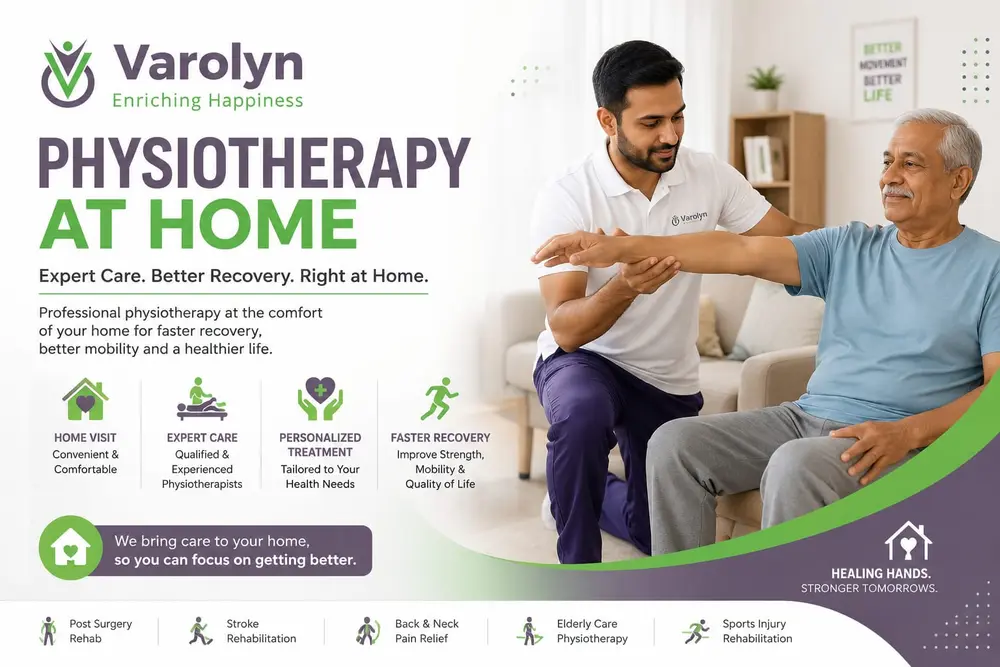
Physiotherapy at home in Bangalore changes this completely. A trained, qualified physiotherapist comes directly to your house, at a time that suits your family. Your loved one rests in a familiar, comfortable environment, gets personalised one-on-one attention, and recovers faster. No traffic. No waiting. No exhaustion before the session even starts.
This guide covers everything you need to know — the benefits, the conditions treated, what a home session looks like, who is a good candidate, and how to get started with Varolyn Healthcare.
What Exactly Is Home Physiotherapy?
Physiotherapy (also called physical therapy) is a healthcare service that uses guided exercises, hands-on techniques, and specialised equipment to help people move better, manage pain, and recover from injury or illness.
Home physiotherapy simply means a licensed physiotherapist visits your home and delivers the same evidence-based treatment you would receive in a clinic or hospital — but in your own living room, bedroom, or even your garden.
Sessions are personalised. The therapist assesses your condition, understands your daily routine and your home layout, and creates a treatment plan specifically for you. They bring the necessary portable equipment — resistance bands, portable TENS machines (devices that use mild electrical pulses to ease pain), ultrasound therapy units, and exercise tools.
In India, home physiotherapy has grown rapidly over the last decade, and Bangalore — with its large population of tech professionals, senior citizens, and post-surgical patients — has become one of the leading cities for this service.
Who Can Benefit from Physiotherapy at Home in Bangalore?
Home physiotherapy is not just for elderly patients. It benefits a wide range of people across all age groups. Here is a quick look at who gains the most:
- Elderly patients and senior citizens who find travel painful, tiring, or risky — especially those with arthritis (joint inflammation), osteoporosis (weak bones), or balance problems.
- Post-surgical patients recovering from procedures like knee replacement, hip replacement, spinal surgery, or cardiac bypass surgery.
- Stroke survivors who need neurological rehabilitation (retraining the brain and nerves to control movement) and cannot easily commute.
- People with back or neck pain — one of the most common complaints among Bangalore's IT professionals who sit for 8–10 hours a day.
- Sports injury patients — runners, cricket players, gym-goers who need targeted recovery for ligament tears, muscle strains, or fractures.
- Children with developmental delays or conditions like cerebral palsy (a condition affecting movement and posture from birth) who benefit from paediatric physiotherapy at home.
- Patients with neurological conditions like Parkinson's disease (a condition affecting the nervous system, causing tremors and stiffness) or multiple sclerosis.
- Post-COVID recovery patients dealing with weakness, breathlessness, or fatigue after a COVID-19 illness.
- Pregnant women and new mothers needing antenatal or postnatal physiotherapy for pelvic floor health and back pain.
Simply put: if movement is difficult, painful, or limited — home physiotherapy can help.
Top Benefits of Home Physiotherapy — Why It Works Better for Many Patients
Home physiotherapy is not just a convenient alternative — for many patients, it is actually the better option clinically and emotionally. Here is why:
1. Faster Recovery in a Familiar Environment
Research consistently shows that patients heal faster when they feel safe and comfortable. Home is where you relax. When you are not stressed about travel or unfamiliar surroundings, your body responds better to therapy. Pain perception (how much pain you feel) is also lower in a calm, familiar setting.
2. Truly One-on-One Attention
In a busy physiotherapy clinic, a therapist may manage 5–8 patients simultaneously. At home, the therapist's full attention is on you for the entire session — usually 45 to 60 minutes. Every exercise, every technique, every adjustment is personalised to your body and your progress that day.
3. Real-World Exercise Planning
The therapist sees your actual home. They notice the height of your bed, the slope of your staircase, the layout of your bathroom. This means they can design exercises and safety plans that directly apply to your real daily life — not a generic gym or clinic setting. This is especially valuable for fall prevention in elderly patients.
4. No Risk from Travel
For patients recovering from surgery or with fragile bones, even a short car ride can be uncomfortable or risky. For stroke patients, navigating steps and traffic is a genuine hazard. Home physiotherapy eliminates this risk entirely.
5. Family Involvement and Education
When therapy happens at home, family members can watch, learn, and participate. Caregivers learn the correct way to assist the patient with exercises, transfers (helping the patient move from bed to chair, for example), and daily activities. This dramatically improves outcomes between sessions.
6. Consistency and Comfort Lead to Better Compliance
Patients are far more likely to attend all their sessions when the therapist comes to them. Missing sessions is one of the biggest obstacles to recovery. Home physiotherapy naturally reduces missed appointments.
7. Emotionally Reassuring for Anxious Patients
For many elderly patients and those with anxiety, hospitals and clinics feel frightening. Healing at home, with family nearby, is far more emotionally supportive — and emotional wellbeing plays a real role in physical recovery.
Conditions Treated by Home Physiotherapy in Bangalore
Qualified home physiotherapists in Bangalore are trained to treat a wide spectrum of conditions. Here are the most common ones:
Orthopaedic Conditions (Bones, Joints, Muscles)
- Knee and hip replacement rehabilitation — restoring strength, flexibility, and safe walking after joint replacement surgery.
- Fracture recovery — rebuilding muscle strength and joint movement after a cast is removed.
- Arthritis management — exercises and techniques to reduce joint pain and improve mobility in conditions like osteoarthritis and rheumatoid arthritis.
- Back and neck pain — postural correction, spinal mobilisation (gentle movement of the spine), and core strengthening exercises.
- Shoulder injuries — including frozen shoulder (painful stiffness of the shoulder joint), rotator cuff tears, and post-dislocation recovery.
- Sports injuries — ankle sprains, ligament tears (ACL — the ligament inside the knee), muscle strains, and tendonitis (inflammation of a tendon).
Neurological Conditions (Brain, Nerves, and Spinal Cord)
- Stroke rehabilitation — relearning walking, hand movements, balance, and speech-related breathing after a stroke (when blood supply to part of the brain is blocked or reduced).
- Parkinson's disease — improving balance, reducing rigidity (stiffness), and preventing falls.
- Spinal cord injury recovery — maximising the movement and function possible after spinal damage.
- Bell's palsy — facial nerve exercises to regain normal facial movement after nerve damage.
- Multiple sclerosis — managing fatigue, spasticity (muscle stiffness and spasms), and maintaining function.
Cardio-Pulmonary Conditions (Heart and Lungs)
- Post-cardiac surgery rehabilitation — carefully graded (step-by-step) exercises after bypass surgery or a heart attack, done safely at home.
- COPD management — COPD (Chronic Obstructive Pulmonary Disease) makes breathing difficult; breathing exercises and pulmonary rehabilitation help patients breathe more easily and stay active.
- Post-COVID rehabilitation — rebuilding lung capacity, endurance, and strength after COVID-19.
Geriatric and Elderly Care
- Fall prevention — balance training, strength exercises, and home safety assessments to reduce the risk of dangerous falls.
- General deconditioning — when prolonged bed rest or illness has caused weakness, a physiotherapist helps the patient safely regain strength and independence.
- Dementia care support — gentle movement programmes to maintain mobility and reduce agitation in patients with dementia (a condition affecting memory and thinking).
Paediatric (Children's) Physiotherapy
- Cerebral palsy — exercises and techniques to improve posture, movement, and daily function.
- Developmental delays — helping children reach physical milestones like sitting, standing, and walking.
- Club foot and other congenital conditions — ongoing therapy after medical or surgical correction.
What Does a Home Physiotherapy Session in Bangalore Actually Look Like?
If you have never had a physiotherapist come to your home before, you might wonder what to expect. Here is a simple, step-by-step picture of a typical Varolyn Healthcare home physiotherapy visit:
Step 1: Initial Assessment (First Visit)
The physiotherapist arrives at your home and spends time getting to know the patient. They review medical history, recent doctor's reports, and any prescription from the treating doctor. They assess posture, range of motion (how far a joint can move), muscle strength, balance, and pain levels. They also look at the home environment — the bed height, availability of chairs, stairs, and bathroom setup.
Step 2: Goal Setting
Together with the patient and family, the therapist sets clear, realistic goals. For example: "Walk independently to the bathroom within three weeks" or "Reduce lower back pain from 7 out of 10 to 3 out of 10 within four sessions." Goals keep everyone motivated and on track.
Step 3: Hands-On Treatment and Guided Exercise
This is the heart of every session. Depending on the condition, the therapist may use:
- Manual therapy — hands-on techniques like massage, joint mobilisation, and stretching.
- Therapeutic exercises — specific, graded exercises to build strength, improve flexibility, and retrain movement patterns.
- TENS therapy — a small portable device sends gentle electrical pulses to the skin to reduce pain. Completely safe and painless.
- Ultrasound therapy — a device uses sound waves to reduce swelling and promote tissue healing deep inside the body.
- Heat or ice therapy — to reduce inflammation (swelling and redness) or relax tight muscles.
- Gait training — re-learning to walk safely, sometimes with aids like walkers or crutches.
- Breathing exercises — for pulmonary or post-surgical patients.
Step 4: Home Exercise Programme
The therapist gives the patient a set of simple exercises to do between sessions. These are explained clearly, often written down or sent as videos. Family members are shown how to safely assist. This "homework" is crucial — progress happens between sessions, not just during them.
Step 5: Progress Review and Plan Adjustment
At each visit, the therapist checks progress against the set goals. The treatment plan is adjusted as the patient improves. Sessions may be daily, every other day, or twice a week depending on the condition and the doctor's advice.
Home Physiotherapy vs. Clinic Physiotherapy: Which Is Right for You?
Both have their place. Here is a simple comparison to help you decide:
- Home physiotherapy is ideal when: the patient cannot travel safely, is elderly or post-surgical, needs fall prevention, has a neurological condition, or is more comfortable at home.
- Clinic physiotherapy may be preferred when: the patient needs specialised equipment not portable to the home (like a hydrotherapy pool), is highly mobile and independent, or prefers a clinical gym environment for motivation.
- Many patients use both: starting with home visits immediately after surgery or illness, then transitioning to a clinic once they are mobile enough.
For the vast majority of Bangalore patients — especially the elderly, post-surgical, and neurological cases — home physiotherapy delivers equal or better results with significantly less stress and risk.
Home Physiotherapy for Bangalore's Most Common Scenarios
After Knee or Hip Replacement Surgery
Joint replacement surgery is one of the most common major procedures in Bangalore's hospitals. After surgery, physiotherapy is not optional — it is essential. Without it, the new joint stiffens, muscles weaken, and the recovery is incomplete.
Home physiotherapy begins within days of discharge. The therapist works on reducing swelling, regaining range of motion in the new joint, strengthening the surrounding muscles, and progressing to safe, independent walking. Having the therapist at home means exercises are done correctly and safely from day one — no dangerous cab rides to the clinic on a fresh surgical site.
Stroke Rehabilitation
After a stroke, time and consistency are everything. The brain has an amazing ability — called neuroplasticity — to rewire itself and regain lost function, but only with repeated, targeted practice. Home physiotherapy allows stroke survivors to practice movement in their actual living environment — the same chairs they sit in, the same corridor they walk down — making recovery directly relevant to their daily life.
Therapists work on relearning walking, regaining arm and hand function, improving balance, and reducing the risk of falls. Family members learn how to safely assist with transfers and daily activities. This whole-family approach is one of the most powerful parts of home-based stroke rehabilitation.
Back and Neck Pain for IT Professionals
Bangalore is India's tech capital. And sitting at a desk for 8–10 hours a day — often in poor posture — is one of the biggest causes of chronic (long-lasting) back and neck pain.
A home physiotherapist can assess your actual work-from-home setup. They can see the height of your desk, the angle of your screen, the chair you use — and give you personalised advice along with targeted exercises. This is something no clinic-based session can replicate.
Treatment typically includes spinal mobilisation, postural correction exercises, core strengthening (building the muscles that support your spine), and ergonomic (workstation design) advice.
Elder Care and Fall Prevention
Falls are the leading cause of serious injury in people over 65. In Bangalore, where many elderly parents live with working families or alone, the risk is real. A broken hip from a fall can be life-threatening in an older adult.
Home physiotherapy for fall prevention involves balance training, leg strengthening exercises, and a careful home safety assessment — identifying hazards like loose rugs, poor lighting, or slippery bathroom floors. This is one of the highest-impact services Varolyn Healthcare offers for senior citizens in Bangalore.
Safety and Quality: What to Look for in a Home Physiotherapist
Not all home physiotherapy services are the same. Here is what to check before you book:
- Qualification: The physiotherapist should hold a BPT (Bachelor of Physiotherapy) degree, a recognised 4.5-year programme in India, or an MPT (Master of Physiotherapy) for specialised cases. Always ask to verify credentials.
- Registration: They should be registered with the relevant State Medical Council or Physiotherapy Council in India.
- Experience: Look for a therapist with specific experience in your condition — neurological, orthopaedic, geriatric, or paediatric.
- Communication: A good therapist explains everything clearly, listens to the patient, and coordinates with the treating doctor.
- Equipment: The service should bring all necessary portable equipment to the session, hygienically maintained.
- Coordination with your doctor: Home physiotherapy should complement your doctor's overall treatment plan, not replace medical care.
At Varolyn Healthcare, all our physiotherapists are degree-qualified, background-verified, and experienced in home-based care. They work as part of your broader care team, including your doctors and nurses, to ensure seamless, safe recovery.
How Many Sessions Will You Need? A General Overview
Every patient is different, and only your doctor and physiotherapist can advise the right plan for your specific case. That said, here is a general guide to help set expectations:
- Acute (recent, short-term) back or neck pain: Often 6–12 sessions over 3–6 weeks.
- Post-knee replacement surgery: Typically 12–24 sessions over 6–12 weeks, progressing from daily to alternate-day sessions.
- Stroke rehabilitation: This is a longer journey — often 3–6 months or more, with intensity adjusted based on progress.
- Sports injury (e.g., ankle sprain): Often 4–8 sessions over 2–4 weeks for mild to moderate injuries.
- Elderly fall prevention / general strengthening: Ongoing, often 2 sessions per week long-term.
Progress is reviewed regularly. Some patients improve faster than expected; others need more time. The key is consistency, trust, and open communication with your therapist.
Tips to Get the Most Out of Your Home Physiotherapy Sessions
Here are some practical ways to speed up recovery and get maximum benefit from every session:
- Do your home exercises faithfully. The sessions plant the seeds, but daily practice grows the results. Even 15–20 minutes of prescribed exercises per day makes a huge difference.
- Wear comfortable, loose clothing so the therapist can easily assess and treat the affected area.
- Clear a space at home — a mat area in the living room or enough space near the bed for exercises and equipment.
- Keep your doctor's reports handy — X-rays, MRI scans, discharge summaries, and prescription letters help the therapist plan the safest treatment.
- Involve a family member or caregiver in at least some sessions so they can help the patient with exercises between visits.
- Be honest about pain. If an exercise hurts, say so immediately. A good physiotherapist adjusts the plan accordingly. "No pain, no gain" is a myth in rehabilitation — progress should be uncomfortable at times, but never sharp or alarming.
- Stay consistent with timing. Scheduling sessions at a regular time each day or week helps build a routine and keeps recovery on track.
- Eat well and stay hydrated. Muscles and tissues heal faster when the body is well-nourished. Your therapist or doctor can advise on general nutrition goals.
Understanding the Cost of Home Physiotherapy in Bangalore
The cost of home physiotherapy in Bangalore varies based on several factors:
- The therapist's qualification and specialisation — an MPT specialist typically charges more than a general BPT therapist.
- The condition being treated — complex neurological or post-surgical cases may require longer sessions or specialised equipment.
- Session frequency and duration — daily sessions versus twice-weekly sessions differ in total cost.
- Location within Bangalore — areas farther from the therapist's base may involve a small travel component.
- Package vs. per-session pricing — many providers, including Varolyn, offer session packages that work out more cost-effective for longer recovery programmes.
Home physiotherapy in Bangalore is generally comparable to or only slightly higher than clinic rates — but when you factor in the cost, time, and energy of travel for a patient who is unwell, home visits are often the smarter value overall.
We do not list specific prices here because they depend on your individual assessment and care plan. Contact Varolyn Healthcare for a personalised, transparent quote after your free initial consultation.
Why Families in Bangalore Trust Varolyn Healthcare for Home Physiotherapy
Varolyn Healthcare is a trusted name in premium home healthcare across Bangalore. Our home physiotherapy service is built on three promises: clinical quality, compassionate care, and family peace of mind.
- Qualified, verified therapists: Every physiotherapist on our team holds a recognised degree, has verified experience, and is background-checked.
- Seamless care coordination: Our physiotherapists work alongside our home nurses, ICU-at-home teams, and care managers to give you joined-up care — not fragmented services.
- Flexible scheduling: Morning, afternoon, or evening — we work around your family's routine.
- Regular progress reporting: Families receive clear updates after each session. If there is any concern, our clinical team contacts your doctor immediately.
- Portable, well-maintained equipment: All therapy equipment brought to your home is clean, well-maintained, and calibrated for safe use.
- Warm, respectful care: We understand that having a healthcare professional in your home is a matter of trust. Our team treats every patient and family with dignity, patience, and genuine warmth.
Whether you are in Koramangala, Whitefield, Indiranagar, JP Nagar, Yelahanka, HSR Layout, or any other part of Bangalore, Varolyn Healthcare brings expert physiotherapy care to your door.
Ready to Start? Book Your Free Consultation with Varolyn Healthcare
You do not have to navigate recovery alone — and you do not have to put your loved one through the exhausting journey to a clinic every week. Expert physiotherapy care is available right at your doorstep, delivered with warmth, professionalism, and genuine dedication to your recovery.
Getting started is simple. Call us or reach out to Varolyn Healthcare today for a free, no-obligation consultation. Our care team will listen to your situation, assess your needs, and recommend the right home physiotherapy plan — transparent, personalised, and designed around your family's life.
Take the first step toward a stronger, more comfortable recovery — from the place you feel most at home.
📞 Call Varolyn Healthcare now to book your FREE home physiotherapy consultation in Bangalore.
Your recovery. Your home. Your comfort. That is what Varolyn is here for.
Key facts
- Physiotherapy at home eliminates travel-related stress and risk, which is especially important for post-surgical and elderly patients — two of the largest groups requiring physiotherapy in Bangalore.
- India's home healthcare market, including home physiotherapy, is one of the fastest-growing healthcare segments, driven by an ageing population, rising surgical volumes, and increasing awareness of rehabilitation.
- Falls are the leading cause of injury-related death and disability in adults over 65 — and home physiotherapy-based fall prevention programmes have been shown to significantly reduce fall risk in elderly patients.
- After a stroke, the brain's ability to rewire itself (called neuroplasticity) is highest in the first weeks and months — making consistent, early home-based rehabilitation critical to maximising recovery of movement and function.
- A Bachelor of Physiotherapy (BPT) is a 4.5-year undergraduate programme in India; patients should always verify that their home physiotherapist holds a recognised BPT or MPT (Master of Physiotherapy) degree.
- Post-surgical physiotherapy — including after knee and hip replacement — is not optional; without rehabilitation, new joints can stiffen, muscles weaken, and the patient may not regain full function regardless of the surgery's technical success.
- Bangalore is home to one of India's largest populations of IT professionals, a group with very high rates of chronic neck and lower back pain due to prolonged desk work — making home physiotherapy with ergonomic assessment particularly valuable in this city.
Frequently asked questions
Is home physiotherapy as effective as clinic physiotherapy?
Yes — for most conditions, home physiotherapy is equally effective, and for many patients (especially the elderly, post-surgical, and neurological cases) it is actually more effective. The patient is in a familiar, comfortable environment, receives full one-on-one attention, and the therapist can design exercises based on the patient's real home layout and daily life. Studies consistently show that patient compliance (sticking to the programme) is also higher with home visits.
What conditions can be treated with physiotherapy at home in Bangalore?
A wide range of conditions can be treated at home, including post-knee or hip replacement recovery, stroke rehabilitation, back and neck pain, arthritis, Parkinson's disease, sports injuries, fracture recovery, COPD and post-COVID breathlessness, cerebral palsy in children, and general weakness or deconditioning in elderly patients. Your Varolyn physiotherapist will assess your specific condition and confirm whether home treatment is the right approach.
How do I prepare my home for a physiotherapy session?
You don't need to do much. Clear a small space — ideally a room where the patient can lie down on a mat or on the bed, and where there is room to walk a few steps. Wear loose, comfortable clothing. Have any medical reports, X-rays, MRI scans, or discharge summaries ready for the first visit. The physiotherapist will bring all necessary portable equipment and will guide you through everything else.
How many home physiotherapy sessions will my family member need?
This depends entirely on the condition, the patient's age, overall health, and how consistently the home exercise programme is followed. A simple back pain case might resolve in 6–10 sessions. Post-knee replacement recovery typically takes 12–24 sessions. Stroke rehabilitation can continue for months. Your Varolyn physiotherapist will set clear goals and review progress regularly, adjusting the plan as the patient improves.
Is home physiotherapy safe for elderly patients with multiple health conditions?
Yes, when delivered by a qualified physiotherapist who is aware of all the patient's conditions and medications, home physiotherapy is very safe for elderly patients. In fact, it is often safer than clinic visits, because it eliminates the risks of travel, falls in unfamiliar environments, and exposure to infections in crowded waiting rooms. Our Varolyn physiotherapists are experienced in geriatric (elderly) care and coordinate with the patient's doctors to ensure every session is safe and appropriate.
What equipment does a home physiotherapist bring?
A trained home physiotherapist typically brings portable equipment such as resistance bands and exercise tools, a portable TENS machine (for pain relief using gentle electrical pulses), an ultrasound therapy device (for reducing swelling and promoting healing), hot or cold packs, and a treatment mat. They may also use simple household items — a sturdy chair, a wall, or a step — as part of the exercise programme. Everything is hygienically maintained and safe for home use.
Can home physiotherapy help with post-COVID recovery in Bangalore?
Absolutely. Many COVID-19 survivors in Bangalore experience lingering fatigue, breathlessness, muscle weakness, and reduced exercise tolerance — a condition often called Long COVID. Home physiotherapy can help through breathing exercises to improve lung capacity, gentle aerobic and strengthening exercises to rebuild stamina, and energy conservation techniques. The therapist progresses the programme gradually and safely based on how the patient feels each day.